The Jew Of Malta
20 June 2015
4 Stars
In the real world, Greece is teetering on bankruptcy. A greater power, The European Union, is telling Greece how to behave, what to pay and when, or face dire consequences. What would happen, one wonders, if the Greek government suddenly decreed that every millionaire had to forfeit all of their assets (save, say, €500,000) to assist the greater good? What if the millionaires refused? They would lose everything and face incarceration. If you were a Greek millionaire, what would you do? Quietly acquiesce? Submit but fight to bring down the Government that stole your lifestyle?
Essentially, this is the topic explored by Christopher Marlowe in his 1591/1592 play, The Jew Of Malta, a piece which predates Shakespeare's more well known play about a Jew seeking vengeance: The Merchant Of Venice. Marlowe's influence on Shakespeare is clear. In both plays, the central Jew loses wealth and daughter; while Shylock is forced to become a Christian at the end, Marlowe's Jew is stripped of his faith very early on. Both Jews suffer cruel Christian "justice" and both are reviled by their Christian contemporaries. But there the similarities end.
People argue about Shakespeare's "problem" play, unsure if it is a comedy or a drama. Different productions provide different answers. It's the same with Marlowe's play: T.S. Eliot thought the play "farce...savage comic humour"; the first printing in 1633 described it as "a famous tragedy". Even Polonious would have trouble categorising it. But Elliot seems on the money: the play is extreme, ridiculous, satirical and grotesque. Approaching it as savage, bitter farce seems most likely to unleash its inner rapture.
Now playing at the RSC's Swan Theatre is Justin Audibert's revival of The Jew Of Malta. Making his directorial debut, Audibert does not follow Elliot's advice, but steers a safer course, through the waters of tragedy and tragicomedy, ultimately coming to hazard, when the audience does not know whether to laugh or be shocked, as the wheels of murderous vengeance turn more and more frantically. Given the cast he has assembled and the brio he manages at half speed, it seems a seriously missed opportunity that Audibert was not brave enough to power ahead, full throttle constantly engaged.
It's not as if the text is absent clues about how the playing might best be achieved - full, fruity, barnstorming performances are needed. This is a play where the inhabitants of a Nunnery are slain by poisoned porridge; where the daughter of a Jew becomes a Christian Nun, twice; where, having purchased a Thracian slave, owner and slave engage in a bout of one-upmanship about the vile deeds they claim to enjoy; where Friars are referred to as "religious caterpillars"; where the Jew inquires if theft is the basis of Christianity; where a Friar casually asks if the Jew has been "crucifying children"; and where no one, really, has any redeeming features. It all but screams farce, even if some of the subject matter is repugnant and, sadly, deadly accurate.
The trouble is that the playing in the Swan has a weight about it which confuses the audience. When the Jew and his slave, Ithamore, murder the old friar, Bernardine, this exchange occurs:
Bernardine: What do you mean to strangle me?
Ithamore: Yes, 'cause you use to confess.
Barabas: Blame not us but the proverb, 'Confess and be hanged'. Pull hard.
Bernardine: What, will you have my life?
Barabas: Pull hard, I say, you would have had my goods.
It is an indisputably funny exchange, even though it turns on foulest murder. Yet, even though this exchange occurs in the fourth Act, the audience don't feel secure enough to laugh. Some do, but others think them tasteless for so doing. The trouble is that it is meant to be funny, should be funny, but uncertainty shrouds the auditorium - and that is down to Audibert's direction - not embracing the almost carnal pleasure to be had from the lip-smacking, obsidian humour.
Perhaps a clearer example comes when the Jew's daughter, Abigail, knowing that she is dying, confesses her father's involvement in the death of her two Christian suitors:
Abigail: ...pray keep it close, Death seized on my heart, ah gentle friar,
Convert my father that he may be saved,
and witness that I die a Christian.
Bernardine: Ay, and a Virgin too, that grieves me most.
Yet, the audience did not feel empowered to laugh, when clearly Marlowe intended laughter. Shocking, shocked, and uneasy laughter perhaps, but laughter none the less.
Brighter, bolder, more obviously fruity and irreverent playing from the gifted cast would solve these problems.
Jasper Britton carries the bulk of the play as Barabas, the titular Jew. Long lank strands of hair, bulging eyes which can dance furtively or fix with feral zeal, a booming resonant voice, and a wondrous sense of clarity of purpose - Britton has all the tools he requires to make the most of the role. And he is eminently watchable. It's just that he does not ascend to the heights of hilarity and darkness that the part would be best served by. He can clearly do what should be done; he just isn't asked to do that. He brings gravitas when there should be eccentric, vicious jocularity. If he could but imbue the performance with both, it would be a sensation.
There are excellent supporting performances all round, but none are as extreme as might be hoped for. Carton Stewart is in good form as the twice-Nunned Abigail and Lanre Malaolu excels as the wily slave, Ithamore, who is willing to do anything to anyone to save his own skin and better his life.
Unctuous and pontificating, both Matthew Kelly and Geoffrey Freshwater are notably awful Friars; a bit more sleaze would see these grasping caterpillars exactly right. Steven Pacey is all duplicitous swashbuckling officiousness as Ferneze, the weak ruler who starts and finishes the cycle of theft and murder which characterises the play. Beth Cordingly and Matthew Needham are suitably colourful and idiosyncratic as a calculating prostitute and her avaricious pimp.
Colin Ryan and Andy Apollo have a deal of fun as the rival suitors for the hand of Abigail. Indeed, Apollo's preposterous peacock Don Lodowick comes closest to hitting exactly the right farcical style.
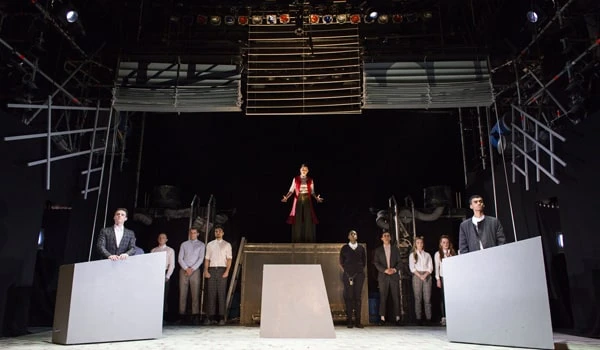
Lily Arnold's set is functional (a set of steps and a small pool) but not particularly fabulous. Oliver Fenwick manages to create some excellent mood lighting and together with Jonathan Girling's effective score achieves clear delineation of the three races at war here: Christian, Jew and Islam.
This is a good production of a great play with a great cast. Unleash their inner savage lunatic, and it would be a great production. It's a bit like a steamed pudding: great ingredients, great recipe; but without the cream and custard, it just doesn't zing.
The Jew Of Malta runs at the Swan Theatre, Statford until 29 August 2015
Stephen Collins is a contributor at British Theatre, covering West End productions, London theatre news, casting updates, and UK stage trends.
Stay in the spotlight
Get the latest theatre news, reviews and exclusive offers straight to your inbox.