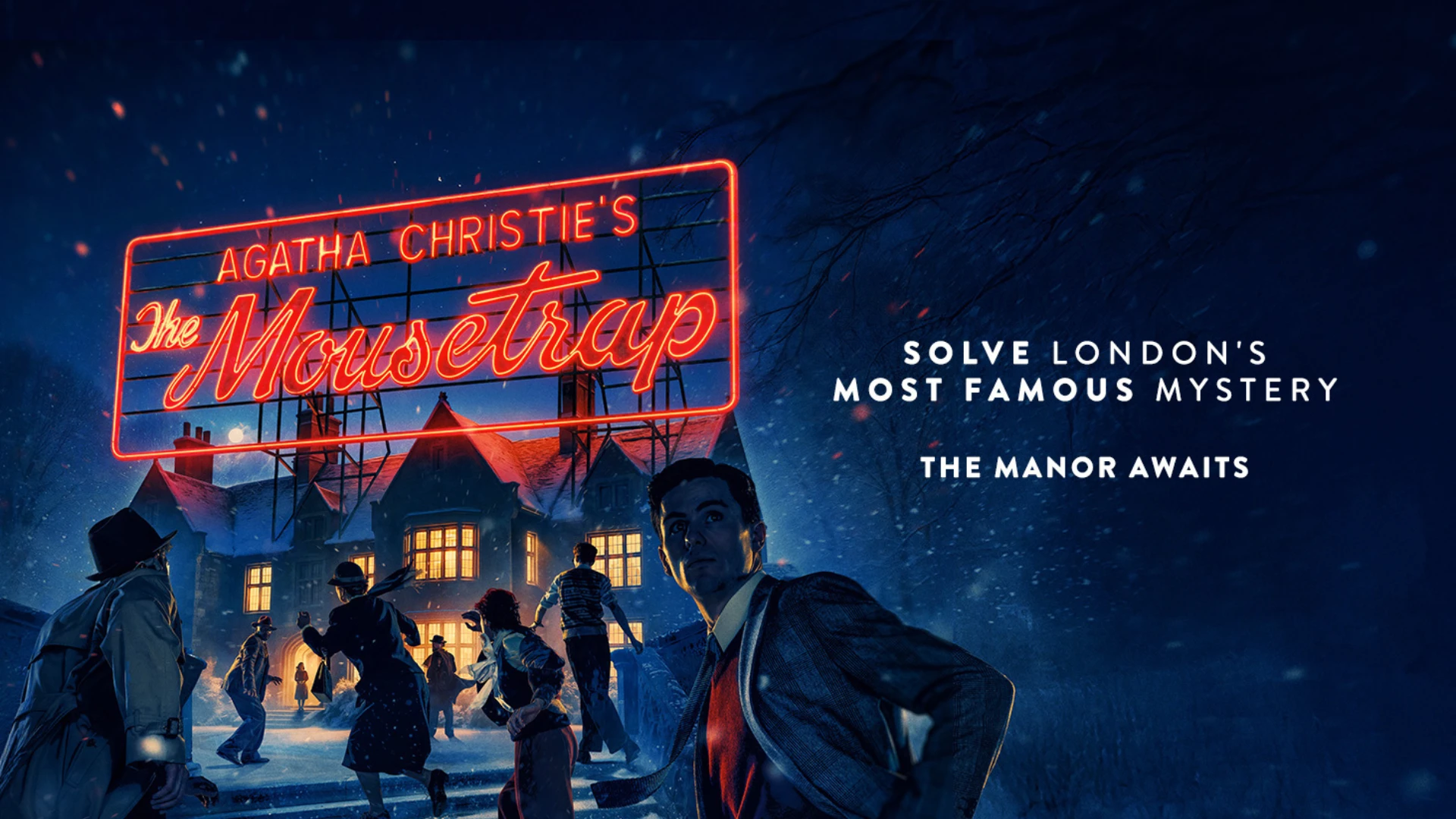
The Mousetrap at the St Martin's Theatre on West Street in the West End has been running without interruption since it opened in November 1952, making it the longest-running play in the world by a considerable margin. Agatha Christie's whodunnit murder mystery began its life as a short story, became a radio play and was then adapted by Christie herself for the stage. What has kept it running for more than seven decades is a combination of the material's qualities (a compact, well-constructed mystery that works on first viewing) and an institution of sorts that has grown up around it. This guide covers the play's background, the story, the tradition of secrecy associated with the ending, what to expect at St Martin's Theatre, and the practical information visitors need before booking.
The Mousetrap was written by Agatha Christie and adapted from her short story Three Blind Mice, which she had originally written as a radio play for BBC Radio to mark Queen Mary's eightieth birthday in 1947. The stage adaptation was produced by Peter Saunders and opened at the Ambassadors Theatre on 25 November 1952. It ran at the Ambassadors for just over twenty-one years before transferring to the adjacent St Martin's Theatre in March 1974, where it has remained ever since.
Christie herself was doubtful that the play would run for more than a few months. Her scepticism proved spectacularly wrong: the play attracted audiences from its opening and sustained them across the decades. The production has been performed many thousands of times, and the accumulated audience of The Mousetrap over its run now represents one of the largest totals in theatrical history.
The St Martin's Theatre has been the exclusive home of the production since 1974, and the association between the play and the building is now so established that most of the theatre's audience at any given performance is attending specifically for The Mousetrap rather than because they are regular theatregoers at that venue. The play is among the most significant single-show cultural institutions in London, and it occupies a position in the city's theatrical life that is entirely its own.
The Mousetrap is set in Monkswell Manor, a guest house that has recently opened in a large country house managed by the young couple Mollie and Giles Ralston. As the first guests arrive during a snowstorm, news reaches the manor that a murder has been committed in London. The snowstorm cuts the house off from the outside world, and when Detective Sergeant Trotter arrives on skis to investigate a connection between the murder and the people at Monkswell Manor, the guests find themselves confined together in circumstances that quickly become dangerous.
The play's seven principal characters each have secrets, and the tight timeframe of the action (the events of the play take place over a single day) keeps the dramatic pressure high throughout. The murder mystery form that Christie perfected over decades of novel-writing is used here with economical precision: the clues are present, the red herrings are carefully placed and the logic of the solution is consistent with everything the audience has witnessed.
The ending is not discussed in this guide. The tradition of keeping it secret is covered in the section below, and it is worth observing that part of the distinctive pleasure of The Mousetrap is arriving without knowing the solution and being genuinely surprised by it.
One of the elements that has become most associated with The Mousetrap is the tradition of asking audience members not to reveal the ending to those who have not yet seen the play. At the end of each performance, an address from the stage invites the audience to keep the secret of the final revelation so that future audiences can experience the same surprise.
This tradition has been maintained across seven decades and the many millions of audience members who have seen the play. It has become part of the cultural identity of The Mousetrap, contributing to its status as an institution rather than simply a theatrical production. The tradition also speaks to the durability of the mystery's central construction: the ending remains a surprise to audiences who have not been told it in advance, which is itself a testament to Christie's craftsmanship.
For audiences visiting The Mousetrap for the first time, arriving without prior knowledge of the ending is by far the most rewarding approach. The play is constructed to conceal what it reveals, and experiencing it without foreknowledge is the best way to understand why it has held audiences for so long.
The production at St Martin's Theatre is a West End staging that reflects the character of the play's origins: period setting, traditional staging and a straightforward relationship between the audience and the drama. The play is not a spectacle production: there are no large-scale technical effects, elaborate set transformations or elaborate staging devices. The pleasure of The Mousetrap is almost entirely derived from the script and the performances, which is in itself a reminder of what classical mystery drama can achieve without any resources beyond a well-written play and a capable cast.
The running time is approximately two hours with one interval. The pace of the play is brisk: Christie's construction moves efficiently from setup to complication to resolution, and the two-act structure is well-calibrated to maintain tension through the interval and to resolve the mystery in the second act with enough time to absorb what has happened.
For audiences who are unfamiliar with stage plays in the classical British tradition, The Mousetrap provides an accessible and engaging introduction: the story is immediately comprehensible, the characters are clearly drawn and the mechanics of the mystery are designed to involve the audience actively in speculating about the outcome.
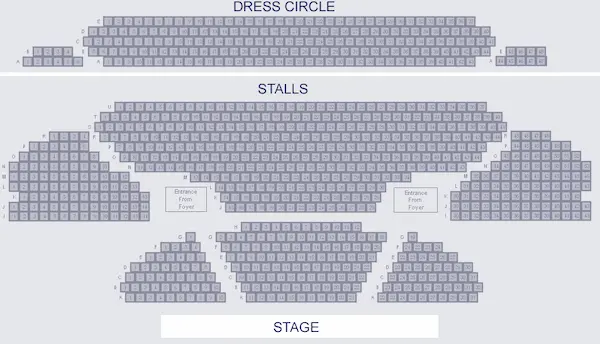
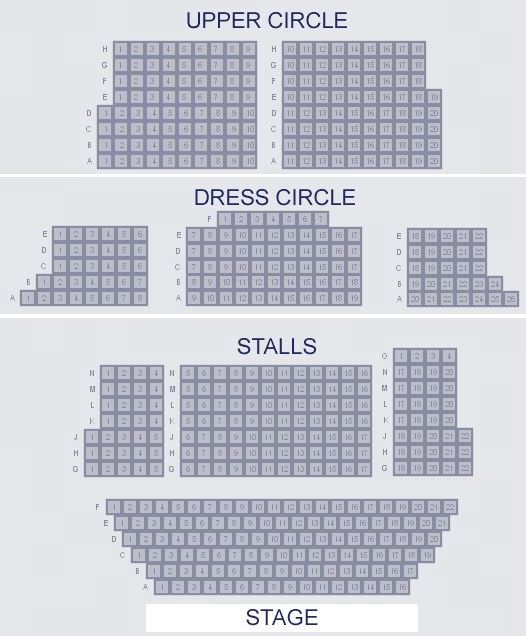
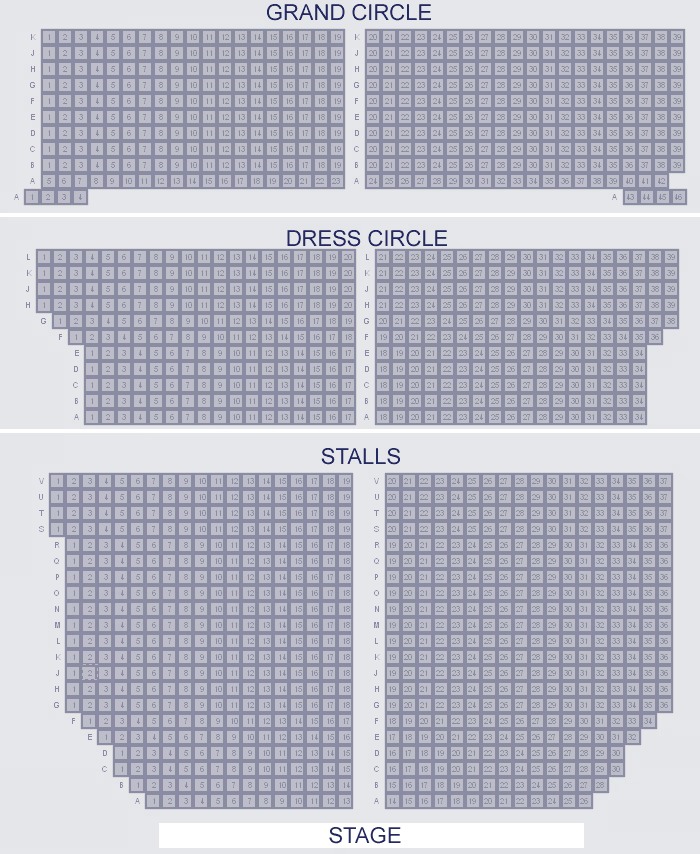
The St Martin's Theatre is a small proscenium house with a capacity of approximately 550 seats across three levels. The relatively small scale of the auditorium means that the differences between positions are less marked than in larger venues, and most seats provide a reasonable view of the stage.
The Stalls provides the most immediate engagement with the production. The mid-Stalls central block from rows D or E to around row M gives a good combination of proximity and full-stage sightlines. The very front rows place the audience close to the stage, which works well in such an intimate house, but the angle looking upward can be uncomfortable for taller staging elements.
The Dress Circle at St Martin's is elevated and gives the overview perspective that many audiences prefer for drama. In a house of this scale, the Dress Circle is not significantly remote from the stage, and the acoustic quality across both levels is good throughout. The central front rows of the Dress Circle are among the most valued positions in the house for audiences who prefer a clear overall picture of the staging.
The Upper Circle provides a complete view at the lowest price. At a venue of around 550 seats, the Upper Circle is not the isolation it would represent in a larger theatre, and for audiences where price is the primary consideration, central upper positions represent genuine value.
The St Martin's Theatre is on West Street, a short turning between St Martin's Lane and Cambridge Circus in Covent Garden. The nearest Underground station is Leicester Square (Northern and Piccadilly lines), approximately three to four minutes on foot. Covent Garden station (Piccadilly line) is also nearby, approximately five minutes on foot.
The area around St Martin's Theatre is one of the most concentrated parts of Theatreland, with several other major West End venues within a short walk, and the Covent Garden and St Martin's Lane areas provide a good range of pre-theatre dining options at various price points.
For tickets to The Mousetrap at the St Martin's Theatre and the complete West End programme, tickadoo provides full seat availability with an interactive seat map and pricing at all levels. For the full listing of current and upcoming productions, BritishTheatre.com covers all venues and shows. tickadoo also offers theatre gift vouchers.
What is The Mousetrap? The Mousetrap is a murder mystery play by Agatha Christie that has been running continuously at the St Martin's Theatre in London since it opened in 1952. It is the longest-running play in the world.
Where is The Mousetrap playing? The Mousetrap plays at the St Martin's Theatre on West Street in London's West End, where it has been staged since 1974.
How long has The Mousetrap been running? The Mousetrap opened on 25 November 1952 and has been running continuously since, making it the longest-running play in the world with a run of more than seven decades.
Can I find out the ending of The Mousetrap before I see it? Audiences are traditionally asked to keep the ending of The Mousetrap secret so that future audiences can experience the surprise. This tradition has been maintained since the play's opening, and arriving without knowing the ending is strongly recommended for the best experience.
How long is The Mousetrap? The Mousetrap runs for approximately two hours with one interval.
Stay in the spotlight
Get the latest theatre news, reviews and exclusive offers straight to your inbox.