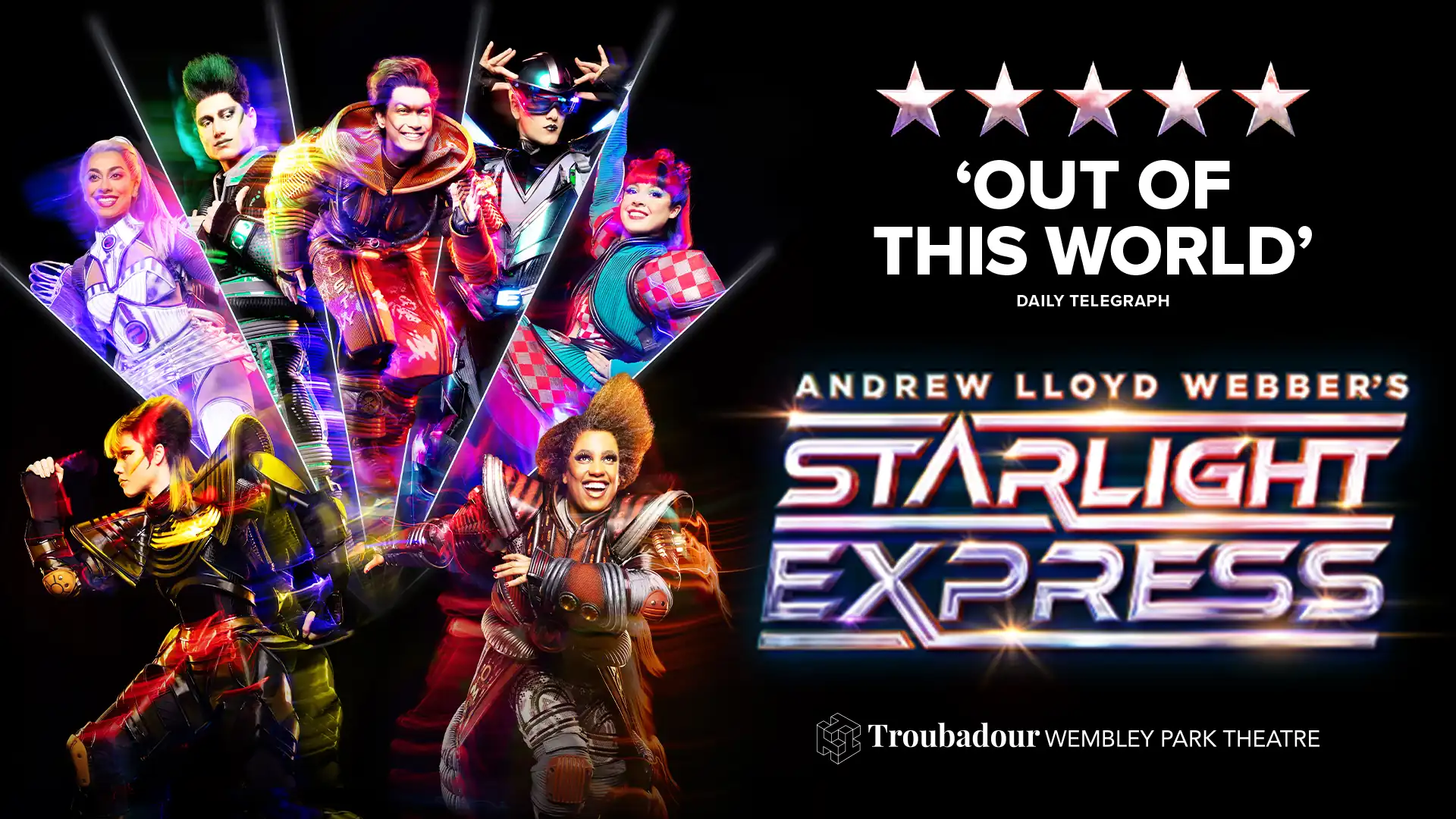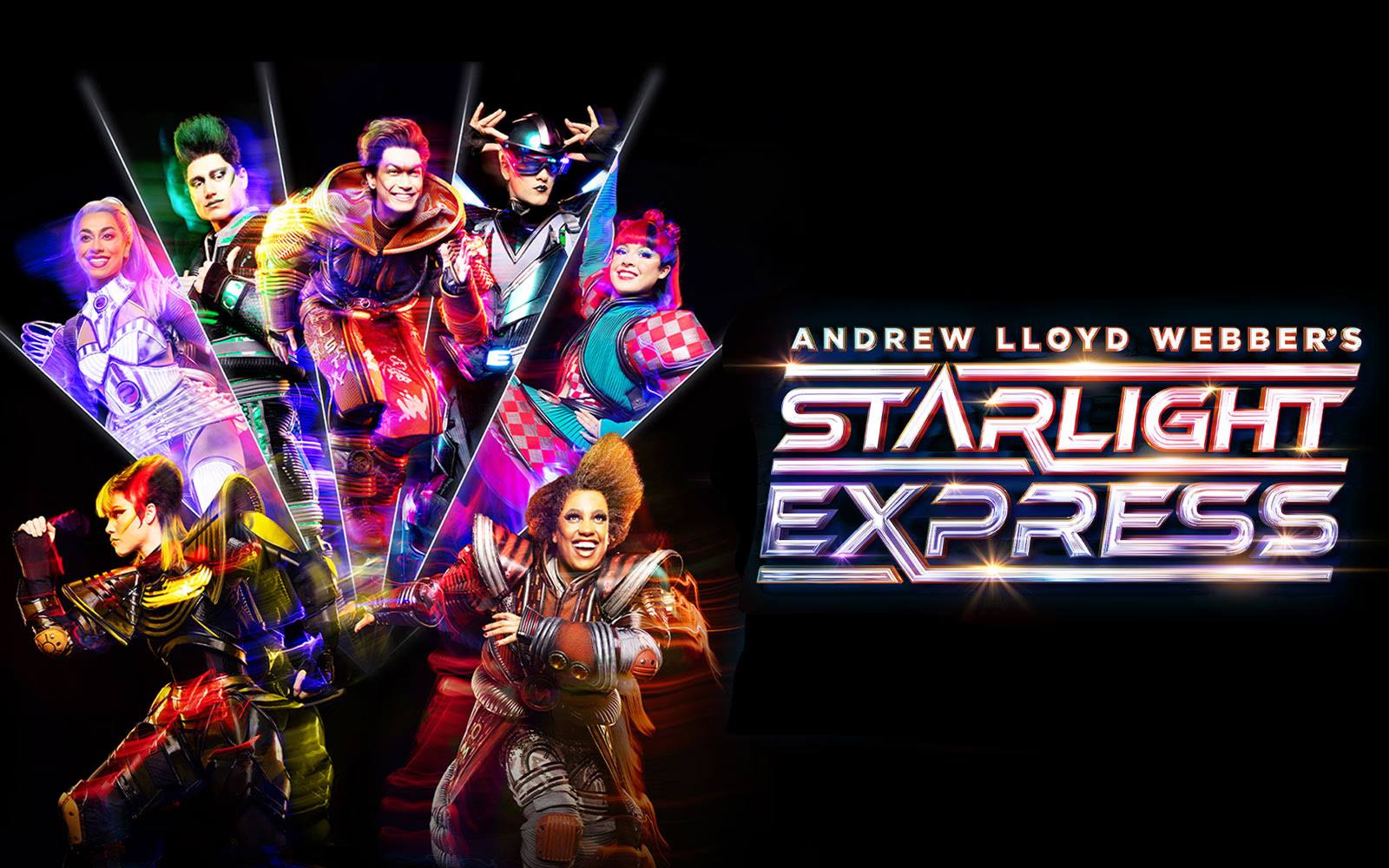
Starlight Express is one of the most singular experiences in the London theatre calendar. Andrew Lloyd Webber's roller-skating musical, which has a history stretching back to its original West End opening in 1984, has returned in a revival production that is among the most technically ambitious theatre productions of its era. This guide covers the show, the unique venue, the staging, age guidance, seating, and the practical information for a visit.
Starlight Express was created by Andrew Lloyd Webber (music) and Richard Stilgoe (lyrics), and originally opened at the Apollo Victoria Theatre in London in 1984. The show runs its entire performance on roller skates, with the cast portraying toy trains competing in a race, and the original production was notable for its use of roller-skating tracks that extended into the auditorium and through the audience. The show ran in the West End until 1992 and subsequently continued for many years in Germany, where it developed a devoted international following.
The 2023 revival brought Starlight Express back to London in a purpose-built theatre at Wembley Park. The new production was designed from the beginning to make full use of a custom venue, with tracks extending through and around the audience in configurations that go beyond what the original Apollo Victoria staging achieved. The Troubadour Wembley Park Theatre was constructed specifically for this production, and the show and the building are inseparable in the experience they create.
The story of Starlight Express is told through the lens of a child's imagination: the characters are the trains from a toy train set, brought to life in a dream race. Rusty is a steam engine who believes he can win the race despite being older and less powerful than the other competitors. His rivals include Greaseball, the self-confident diesel, and Electra, the sleek and arrogant electric engine. Pearl is the dining car pursued by all three.
The race itself is structured across three heats and a final, with the drama and the romantic stakes building through each section. The show's message, about resilience, self-belief and the value of older things in a world that prizes the new and the fast, gives it an emotional underpinning that operates differently for child and adult audiences. Children respond to the spectacle and the energy of the competition; adults tend to find more resonance in Rusty's struggle to be taken seriously.
The show was updated for the revival, with elements of the score revised and new staging developed for the new venue. The core story and most of the principal songs remain, but the production is not a reproduction of the 1984 original.
Andrew Lloyd Webber's score for Starlight Express is one of his most kinetic and varied: the show requires music that drives the pace of racing sequences while also carrying the emotional weight of the romantic storyline and Rusty's central arc.
"Starlight Express" is the show's emotional centre, a ballad in which Rusty calls on the mythical Starlight Express for help and belief. The song anchors the show's tone and the resolution it reaches is what gives the racing spectacle its emotional significance.
"Rolling Stock" introduces the freight cars and establishes the competitive landscape with propulsive energy. "Only He" and the various romantic numbers give the show its more intimate moments between the race sequences.
The score supports the physical spectacle of a cast on roller skates at speed, and the live orchestra experience in a venue specifically built for the production is one of the most immersive in the West End programme.
Starlight Express runs for approximately two hours thirty minutes, including one interval.
The age guidance is five years and above. The show is a strong family production: the story is clear and accessible for young children, the visual spectacle is immediate and thrilling, and the emotional content is appropriate for all ages. The racing sequences are loud and fast, and some younger children may find the proximity of the skating cast in certain positions exciting or overwhelming; parents of very young children should consider this.
For older children aged seven and above, Starlight Express is typically an exceptional theatre experience. The combination of a story they can follow, music they can engage with, and a physical spectacle unlike anything they will see elsewhere makes it one of the most distinctive family theatre visits available in London.
For adults, the show operates as pure theatrical spectacle of the kind that almost nothing else offers. It requires no prior knowledge and rewards attention on multiple levels simultaneously.
The Troubadour Wembley Park Theatre was purpose-built for the Starlight Express revival at the Wembley Park development in north-west London. The building's design is entirely determined by the needs of the production: the tracks run through the audience, over the heads of certain seating areas, and in configurations that place the skating cast within feet of the audience at multiple points during the performance.
This is not a conventional theatre visit. The audience is not seated in rows facing a fixed stage; the action surrounds them, comes from multiple directions and uses the full three-dimensional space of the venue. Different seating positions offer fundamentally different perspectives on the race sequences, and there is no single "best" vantage point in the traditional sense.
The venue is large, designed to accommodate significant audiences for each performance, and the production values are calibrated for a space of this scale. The live orchestra, the lighting and the sound design are all integrated into the building's specific configuration.
Because the venue is purpose-built and immersive rather than a conventional proscenium theatre, seating guidance differs from the standard West End approach.
Track-side positions place the audience closest to the skating cast as they pass at speed. These give the most visceral experience of the performance and the clearest sense of the physicality involved in the roller-skating sequences. The proximity can feel intense and is particularly suitable for audience members who want full immersion.
Elevated positions give a broader overview of the racing sequences and make it easier to follow the narrative action across the full venue. For audience members who want to see the whole picture of a race simultaneously, an elevated position is more effective.
Central and floor-level seating places the audience within the main racing space. The action passes around and through this area, and the experience of being surrounded by the competition is unlike anything a traditional theatre visit offers.
For a first visit, understanding that the experience is three-dimensional and immersive in a way that standard seating advice does not capture is the most important preparation. All positions in the venue offer a valid and engaging experience; the choice is about which version of the show you want.
By Underground: Wembley Park station (Metropolitan and Jubilee lines) is the closest station, approximately five to ten minutes on foot from the Troubadour Wembley Park Theatre. Both lines connect to central London, with the Jubilee line giving direct connections to the West End, London Bridge, Canary Wharf and Stratford.
By National Rail: Wembley Stadium station is served by London Marylebone trains and is also within walking distance of the venue.
By car: Wembley Park has parking facilities associated with the Wembley development. The area is outside the London Congestion Charge zone. Public transport is generally the most reliable option for performance times, as the Wembley Park area can be busy around events at Wembley Stadium.
Starlight Express is unlike any other show in the London theatre programme. The closest comparison for immersive, physically spectacular theatre in a purpose-designed space would be promenade productions or site-specific work, but Starlight Express operates at a scale and with a production value that is its own category entirely.
For families choosing between Starlight Express and more conventional family shows such as The Lion King at the Lyceum Theatre or Matilda the Musical, the key distinction is the experience type. The Lion King and Matilda are proscenium productions of great quality; Starlight Express is something altogether different in form. For families who have seen the conventional productions and want something new, Starlight Express is the most distinctive option available.
For tickets to Starlight Express and all other West End productions, tickadoo covers full availability with seat maps and pricing. tickadoo also offers theatre gift vouchers for family and other occasions.
How long is Starlight Express? The running time is approximately two hours thirty minutes, including one interval.
What age is Starlight Express suitable for? The age guidance is five years and above. The show is a strong family production suitable for children from this age. The racing sequences are physically energetic and loud, and the venue is immersive, which very young children may find intense.
Where is Starlight Express playing in London? Starlight Express plays at the Troubadour Wembley Park Theatre at Wembley Park in north-west London. The nearest Underground station is Wembley Park (Metropolitan and Jubilee lines).
What are the best seats for Starlight Express? Because the venue is purpose-built and immersive rather than a conventional theatre, the experience differs significantly by position. Track-side positions give maximum proximity to the cast; elevated positions provide a broader overview of the racing sequences. All positions in the venue offer a strong experience.
Is Starlight Express suitable for adults without children? Yes. The show works for adult audiences on its own terms as a theatrical spectacle. The scale of the production, the score and the physical achievement of the performance are fully engaging for adults, regardless of whether children are in the party.
Stay in the spotlight
Get the latest theatre news, reviews and exclusive offers straight to your inbox.