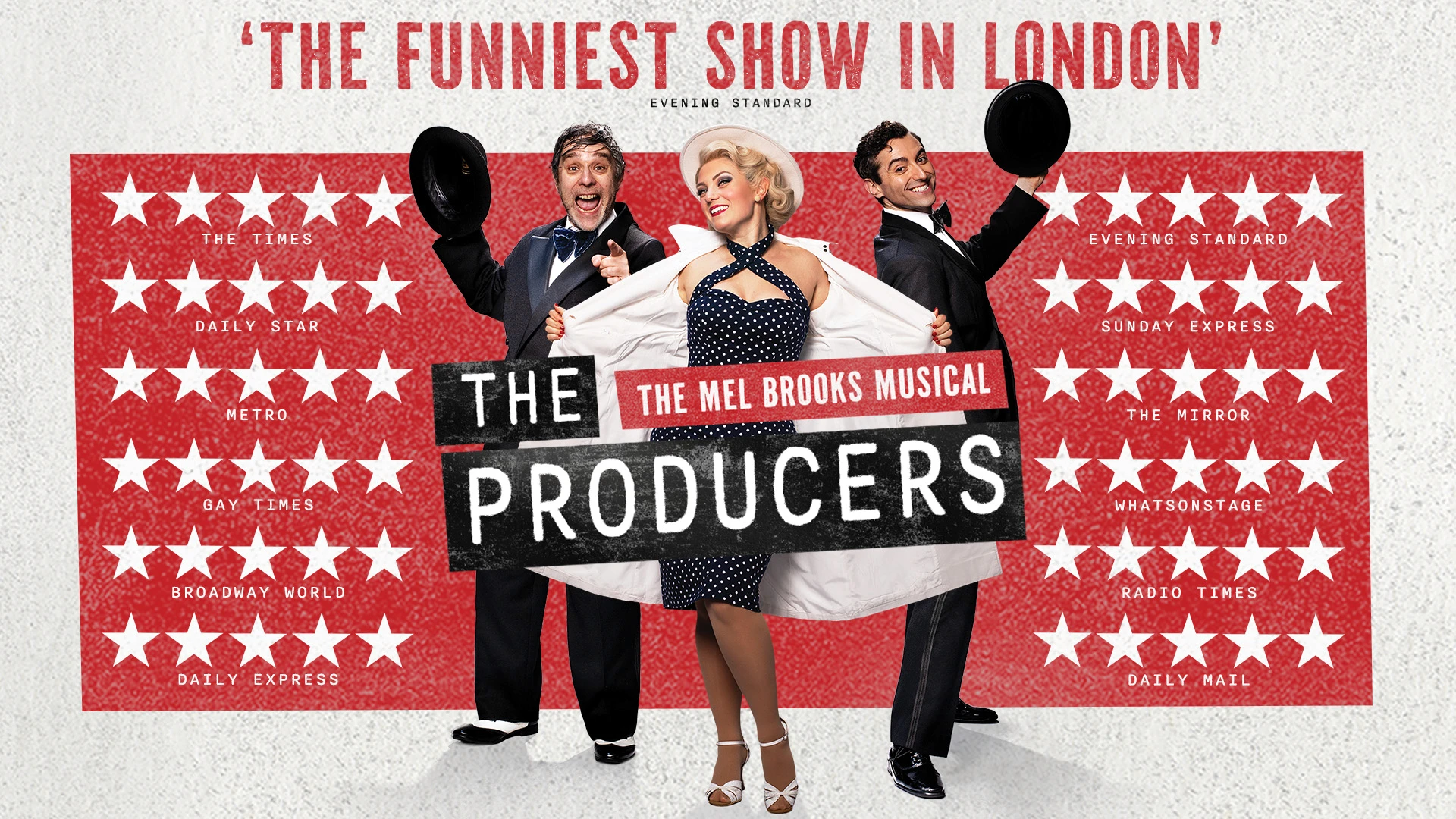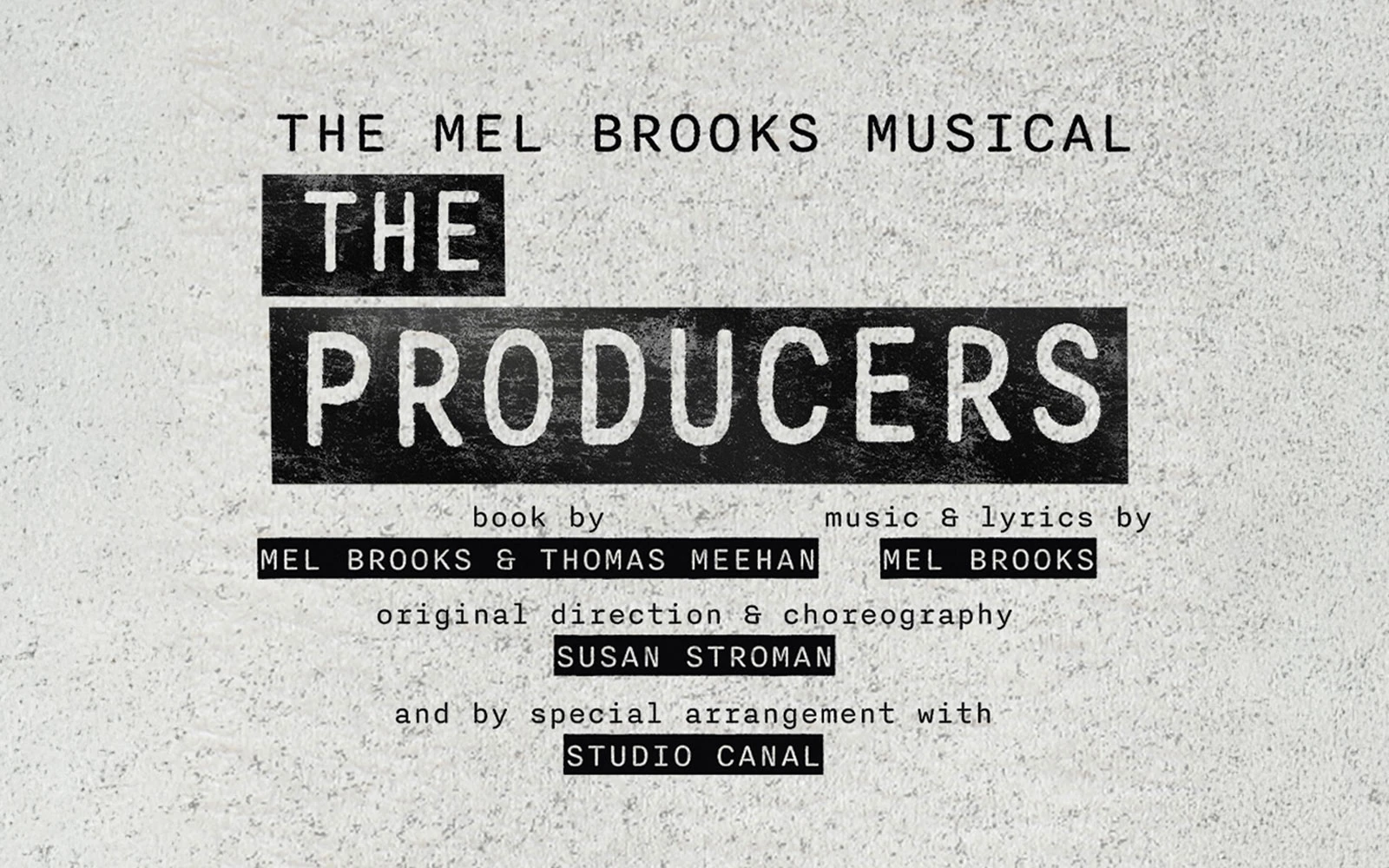
The Producers at the Garrick Theatre on Charing Cross Road brings one of the most celebrated American musical comedies back to the West End stage. Based on Mel Brooks's 1967 film and developed into a stage musical that won twelve Tony Awards when it opened on Broadway in 2001, The Producers is a large-scale farce about fraud, theatrical ambition and the spectacular unpredictability of live performance. This guide covers what the show is, the story, what to expect from the production at the Garrick, how to choose seats, and the practical information visitors need before booking.
The Producers began as a film written and directed by Mel Brooks, released in 1967 and now regarded as one of the great American comedies of the postwar era. The film starred Zero Mostel as Max Bialystock, a disgraced Broadway producer, and Gene Wilder as Leo Bloom, a timid accountant, and the dynamic between these two characters is the engine of the story.
Brooks adapted the film into a stage musical in collaboration with Thomas Meehan, and the Broadway production opened in 2001. Directed and choreographed by Susan Stroman, it won a then-record twelve Tony Awards, including Best Musical, Best Book, Best Original Score and Best Direction. The show transferred to the Theatre Royal Drury Lane in London in 2004, where it ran for two years.
The return of The Producers to a West End stage is an opportunity for audiences who missed its earlier run or who want to see the musical in the more intimate setting of the Garrick, which at around 650 seats is considerably smaller than the Drury Lane. The change in scale affects the character of the experience: the show's comedy, which depends on timing and the physical energy of the principal performers, works particularly well at close range.
The Producers tells the story of Max Bialystock, once the toast of Broadway, now reduced to raising production funds by charming elderly women into writing him cheques. When the nervous accountant Leo Bloom is sent to audit Max's books, he makes an offhand remark that captures Max's imagination: a dishonest producer could make more money with a flop than a hit, if they oversold the investment shares and the show closed quickly enough.
The two men set out to find the worst possible play, sign the worst possible director, cast the worst possible star, and mount the most disastrous production Broadway has ever seen. The play they choose is a musical celebrating Hitler, written by a deranged former Wehrmacht soldier named Franz Liebkind. Everything is designed to guarantee failure. Predictably, it becomes a runaway hit.
The plot's engine is escalating comic misadventure. Each plan to ensure failure produces instead an unexpected, unwanted success, until the scheme collapses under the weight of its own absurdity. The comedy is broad, fast-moving and precise: Brooks is a meticulous craftsman who understands that broad comedy requires more discipline and structure than straight drama, and the show's mechanics are as well-engineered as anything in the musical theatre canon.
The score for The Producers is written in the tradition of classic Broadway musical comedy: big numbers, clear melodies, comic songs that advance the plot and reveal character simultaneously, and ensemble sequences of choreographic energy. Songs including "Springtime for Hitler," "I Wanna Be a Producer" and "Betrayed" are written in the idiom of 1950s and 1960s Broadway showbiz rather than the more contemporary pop-influenced vocabulary of newer musicals.
This gives the show a period character that suits its subject: a show about an older era of Broadway producing, written in the musical language of that era, with deliberate exaggeration for comic effect. Audiences familiar with classic American musical theatre will find the score both reverent and subversive; audiences who know nothing of that tradition will find the musical numbers clear, energetic and immediately entertaining.
The choreography, originally conceived by Susan Stroman with reference to the Busby Berkeley school of show-stopping production numbers, is a significant part of what the show offers. The ensemble sequences are designed to be spectacular, and the incongruity between the scale of the staging and the catastrophic story being told is central to the comedy.
The Garrick Theatre on Charing Cross Road is one of the older surviving Victorian theatres in the West End, with a capacity of approximately 650 seats across three levels. This makes it one of the more intimate commercial theatres available for a production of this kind, and the scale has specific advantages for The Producers.
The show's comedy depends heavily on physical performance and timing. In a large house, the smaller details of a performance can be lost to the back rows; at the Garrick, the audience is close enough to catch everything. The principals' expressions, physical business and the precise timing of comic delivery are all more apparent at this distance, and a production of The Producers benefits directly from that proximity.
The three levels of the Garrick give options at different price points and different distances from the stage. At a venue of this size, no level is truly remote: the Upper Circle at the Garrick is not the isolation of an equivalent level at the Theatre Royal Drury Lane. All three levels offer a meaningful engagement with the production.
Stalls provides the most immediate and proximate experience. For a production driven by physical comedy and performer-audience energy, the Stalls front and mid central block is the ideal position. The front rows are very close to the stage, which suits the farce energy of The Producers: the show plays to the audience with a directness that benefits from proximity. The mid-Stalls from approximately rows D to L gives the best balance of proximity and full-stage sightlines.
Dress Circle offers the elevated perspective and the full-stage picture. The front central rows of the Dress Circle are among the most valued in the house, giving a clear view of the ensemble staging without the ground-level angle of the Stalls. For a show with large production numbers, the Dress Circle reveals the full choreographic picture in a way that close Stalls seats sometimes do not.
Upper Circle provides a complete view of the production at a lower price. At a venue of the Garrick's scale, the Upper Circle is closer to the action than an equivalent level in a larger house, and the acoustic quality at this level is generally adequate for a production that depends on spoken comedy being heard clearly. Central positions in the Upper Circle are the practical choice for audiences where price is the primary consideration.
At all levels, central seats are significantly preferable to restricted-view side positions. The ensemble staging of The Producers uses the full width of the stage, and side seats that cut off part of the action represent a meaningful loss of the experience.
The Garrick Theatre is on Charing Cross Road, close to Cambridge Circus and the junction with Shaftesbury Avenue. The nearest Underground station is Leicester Square (Northern and Piccadilly lines), approximately three minutes on foot. Charing Cross (Bakerloo and Northern lines) is also within ten minutes. The area is within the London Congestion Charge zone; public transport is recommended.
Charing Cross Road and the surrounding Covent Garden and Soho areas offer a wide range of pre-theatre dining options within a short walk.
For tickets to The Producers at the Garrick Theatre, tickadoo covers full seat availability with an interactive seat map and pricing at all levels. The Garrick's intimate scale means good central positions book quickly for popular productions; advance booking is recommended. For the complete West End programme, BritishTheatre.com covers all current productions. tickadoo also offers theatre gift vouchers.
What is The Producers musical about? The Producers follows Max Bialystock and Leo Bloom, who devise a scheme to make money by producing a deliberate Broadway flop. Their plan goes wrong when the show they produce to guarantee failure becomes an unexpected hit.
Where is The Producers playing in London? The Producers is at the Garrick Theatre on Charing Cross Road, near Leicester Square.
Is The Producers suitable for children? The Producers contains satirical content including humour about the Second World War. The show is generally recommended for audiences aged sixteen and above, though this depends on individual maturity. It is not a family show in the sense of being designed for younger children.
What are the best seats at the Garrick Theatre for The Producers? The mid-Stalls central block and the front central rows of the Dress Circle provide the strongest combination of proximity and clear sightlines. At a venue of the Garrick's scale, all central positions offer a good view; avoid restricted-view side seats at any level.
How long is The Producers? The show runs for approximately two hours and thirty minutes with one interval.
Stay in the spotlight
Get the latest theatre news, reviews and exclusive offers straight to your inbox.