Will Keen as Pastor Manders and Lesley Manville as Helene Alving in Ghosts Ghosts Almeida/Trafalgar Studios 12 October 2013
If you have ever pondered the question "What makes a good director?" then attendance at the Almeida's current production of Ibsen's Ghosts, directed by Sir Richard Eyre, might provide some clues.
Many people will have different views about this topic but for my own part I think the requisite attributes are fairly clear. Firstly, the director needs an idea. This might take many forms. The idea might be to make a particular point, to show a particular talent in a different light, to indicate a different way of looking at a text, to demonstrate the modern relevance of an antique work, to show what might have been or what might still be. But underlying every good production of every piece of theatre is a good idea. Sir Richard's idea here seems to be that cold rage is the worst kind. From this single seed everything else flows: seeing is not necessarily believing, that facts are only facts when they are proven and that self-deception on religious or moral grounds is the greatest force for destruction one can imagine. Coldness pervades everything about this production and, like icy diamonds, glitters and sparkles and cuts, often savagely, throughout the roller-coaster of horror that this 90 minute version of Ibsen's text.
Regina, the maid, is cold to her father and he to her; the Pastor, pretending to be full of love and compassion, is cold to all, especially Mrs Alving; Mrs Alving is the personification of coldness and a key issue in the play is why that is so; Oswald is coldest to himself but also to others, except when the fire in his loins inspires activity.
The play might be called Ghosts, but here the participants are more zombie than ghost, living but dead inside, or, perhaps more accurately, ice shadows of what they might have been.The brevity and directness of choice makes for compelling, powerful theatre.
Secondly, the good director needs a cast who can deliver on the idea and who will work with him to achieve it. Here, Sir Richard has demonstrated the fruits a properly cast tree can yield.
All five actors deliver excellent work.
Lesley Manville has never been better than she is here: brittle, desperate, trapped, her Helene Alving is a pulsing stream of artic lava, engulfing everyone around her. Her outward facade of high moral piousness eventually falls to reveal the broken tormented golem inside. Did she pass syphilis to her beloved child at his birth, perhaps after an illicit affair with the Pastor, or did he contract it because he sowed his wild oats in the same sorts of fields his father frequented? The beauty of this production is that the answer matters not: either way, the coldness that comes from lack of honesty, causes the tragedy.
Jack Lowden, so remarkable as the religious champion unwilling to compromise his beliefs for the Olympics in Chariots of Fire, is here both fragile and revolting as the doomed Oswald. He conveys, in extraordinary detail, the horror of the life his mother has carved out for him and from which he wants to rebel, all the while suggesting the reality of the ravages of syphilis. He is truly excellent.
Will Keen is slightly too mannered as the Pastor it seems, but actually, on reflection, that turns out to be the key to his character's own locked up heart, and it represents a point of differentiation both as to substance and class which, in the end, is simple and genius. Keen is perfectly loathsome as the Pastor and beautifully so.
Brian McCardie and Charlene McKenna as the father and daughter/maid/not-daughter/potential future wife of her half-brother are both in remarkable form, easily demonstrating the differences and similarities between what they think their role in the Alving household is and what their role actually turns out to be. Their coldness comes from a different place than the Alvings and the Pastor - it is the coldness born of poverty and desperation, and both of them want to escape from that coldness.
Particularly clever is the way that the playing suggests that Regina resembles Helene, in both form and manner. Whose illicit child is she and from what illicit coupling?
The final desperate moments between Helene and Oswald, after blindness overtakes him, and what is left of her true heart has to face what Helene has overseen over the years, are powerful, shocking and enthralling. Just remarkable to watch.
This is a company of excellent actors working together to perfect a director's vision. So rare to find.
Thirdly, the good director must ensure that the design and execution of the production does not either detract, obfuscate or overwhelm the idea.
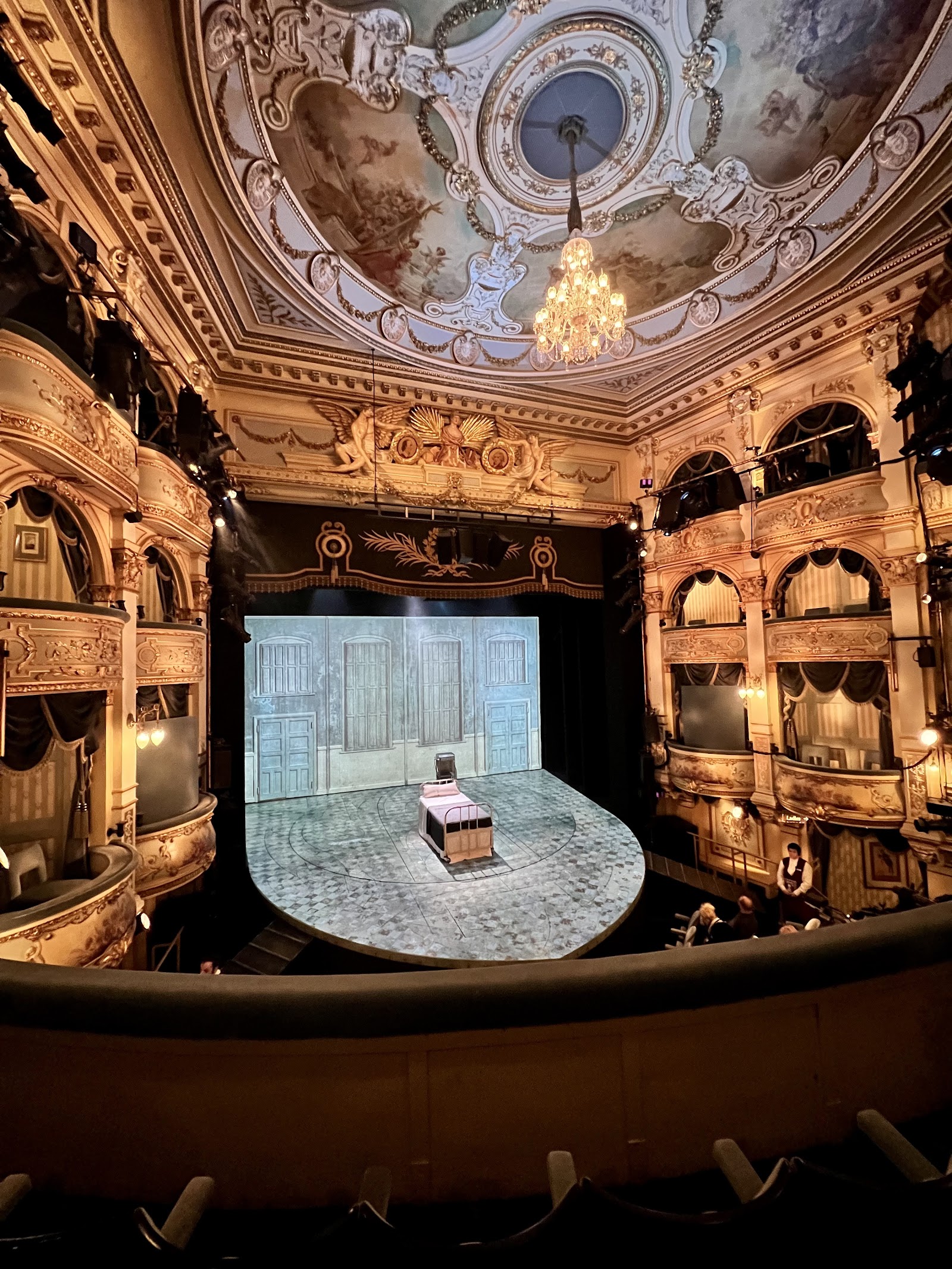
Tim Hatley's simple but effective set is masterful for this production: it sets up the glamour of the Alving house (tattered and slightly worn grandeur) and shows the marks of age and by dividing two areas with glass allows things to be seen and not heard, heard and not seen or just to be shadows, portents or possible reflections.
The set also does not make sense in the way the Alving household does not make sense: the main door is not near the hall. This seems odd at first, but, actually, it is inspirational, reflecting subtlety the madness at the centre of Helene's universe.
Peter Mumford provides exceptional lighting, cold cold cold in every way. Even when the Orphanage burns, the light is icy not red hot.
Every aspect of the production reflects the director's central idea.
It is difficult to imagine seeing a better production of Ghosts than this: it is quite something. And Sir Richard Eyre, at least on this occasion, a director of great vision and ability.
Stephen Collins is a contributor at British Theatre, covering West End productions, London theatre news, casting updates, and UK stage trends.
View profile and all articlesStay in the spotlight
Get the latest theatre news, reviews and exclusive offers straight to your inbox.