In the period after World War II, a Young Vic Company was formed in 1946 by director George Devine as an offshoot of the Old Vic Theatre School for the purpose of performing classic plays for audiences aged nine to fifteen. This was discontinued in 1948, when Devine and the entire faculty resigned from the Old Vic, but in 1969 Dunlop became founder-director of The Young Vic theatre with Scapino, his free adaptation of Molière's The Cheats of Scapin, presented at the new venue as a National Theatre production. It opened on 10 September 1970 and starred Jim Dale in the title role, with designs by Carl Toms (decor) and Maria Björnson (costumes). Initially part of the National Theatre, the Young Vic Theatre became an independent body in 1974. In the words of Laurence Olivier, then-director of the National Theatre: "Here we think to develop plays for young audiences, an experimental workshop for authors, actors and producers." The aim was to create an accessible theatre which offered high quality at low cost in an informal environment. The aim was to appeal to young audiences, but this time not specifically to children.
Dunlop completed creation of the theatre venue in 1970, a breeze-block building constructed out of a former butcher's shop and an adjacent bomb-site with a red wooden slat auditorium bench seating . The structure was intended to last for five years, but has become permanent. The auditorium, with a thrust stage, has an approximate capacity of 420, although the configuration and capacity can vary depending on the design of each production. The theatre undertook a significant rebuilding and renewal project in the 2000s, designed by architects Haworth Tompkins, boosting its visibility on The Cut. In addition to the Young Vic's main house, there are now two smaller theatre spaces. The Maria, named after theatre designer Maria Björnson, is the larger of the two with a capacity of 150. The Clare, named after Clare Venables, a former artistic director of the Young Vic and Sheffield Crucible, seats 70. Like the main house, both smaller theatres have flexible seating configurations which can be arranged to suit the production design. In the two smaller auditoria, seating is usually unreserved, with the actors performing in close proximity to the audience. The Young Vic performs both new writing and classic plays, the latter often in innovative productions. Despite its small size, like the Almeida Theatre, the Young Vic has attracted well-known actors since its creation. These have included Ian Charleson, who made his professional debut with the Young Vic 1972–74, and who played Jimmy Porter in Look Back in Anger and Hamlet in the first revival of Tom Stoppard's Rosencrantz and Guildenstern Are Dead in 1973, as welk as Vanessa Redgrave, Helen Mirren, Judi Dench, Timothy Dalton, Robert Lindsay, Willard White, John Malkovich, Michael Sheen and Arthur Lowe. The rock band The Who held free, weekly concerts at the Young Vic in early 1971, in order to rehearse what would become their album, Who's Next. One of these shows was released on the Deluxe edition of this album. A memorial at the theatre's south-east corner commemorates the fifty-four people killed in 1941 while sheltering in the cellars of the former building during the Blitz of World War II. In 1982, the theatre hosted a Poetry Olympics, where comedian Pat Condell took part. Virginia Woolf taught at Morley College from 1905, a precursor of the Young Vic's education and community engagement programme. The latter now runs an office which accommodates and houses the "homeless" Belarus Free Theatre, of Nikolai Khalezin, Natalia Kaliada, with Sarah Kane's play 4.48 Psychosis performed underground, illegally in Minsk and Farringdon, in the cold cells of Clerkenwell House of Detention, a secret location in London. Echoing the words of Woolf and mirroring her suicide, Kane's play was sponsored by another feminist, Sue Emmas, who since the year 1993 has been associate director of the social engagement programme, working closely with Kwame Kwei-Armah and leads the Directors Program which provides initiatives for emerging directors, with emphasis on seeking out and nurturing artists from under-represented backgrounds.
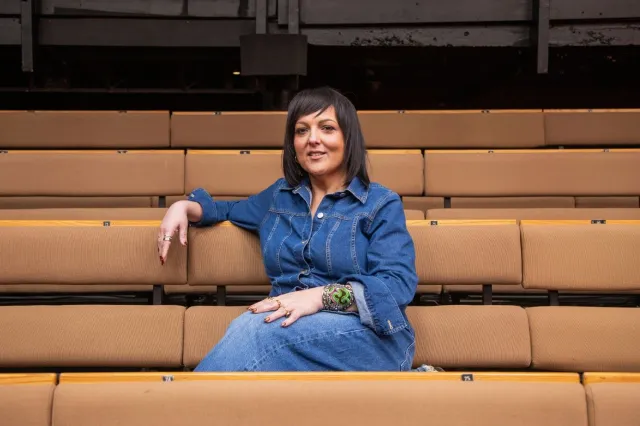
Frank Dunlop (1968–1971, also administrative director) Michael Bogdanov (1971–1973) David Thacker Julia Bardsley and Tim Supple (jointly) (1991–1994) Tim Supple (1994–2000) David Lan (2000–2018) Kwame Kwei-Armah (2018–2024) Nadia Fall (since 2025)
2004 – Laurence Olivier Award for Outstanding Achievement in an Affiliate Theatre 2008 – Laurence Olivier Award for Best Musical Revival – The Magic Flute 2013 – Critics' Circle Theatre Award for Best Musical – The Scottsboro Boys 2016 – Laurence Olivier Award for Best Revival – Yerma 2017 – Critics' Circle Theatre Special Award for Commendation for artistic direction at the Young Vic – David Lan 2018 – Critics' Circle Theatre Award for Best New Play – The Inheritance 2018 – Evening Standard Theatre Award for Best New Play – The Inheritance 2019 – Screen Nation Film and TV Diversity in Drama Award – Soon Gone: A Windrush Chronicle 2019 – Laurence Olivier Award for Best New Play – The Inheritance