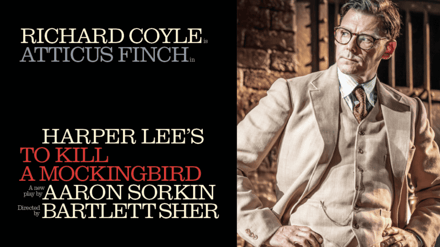
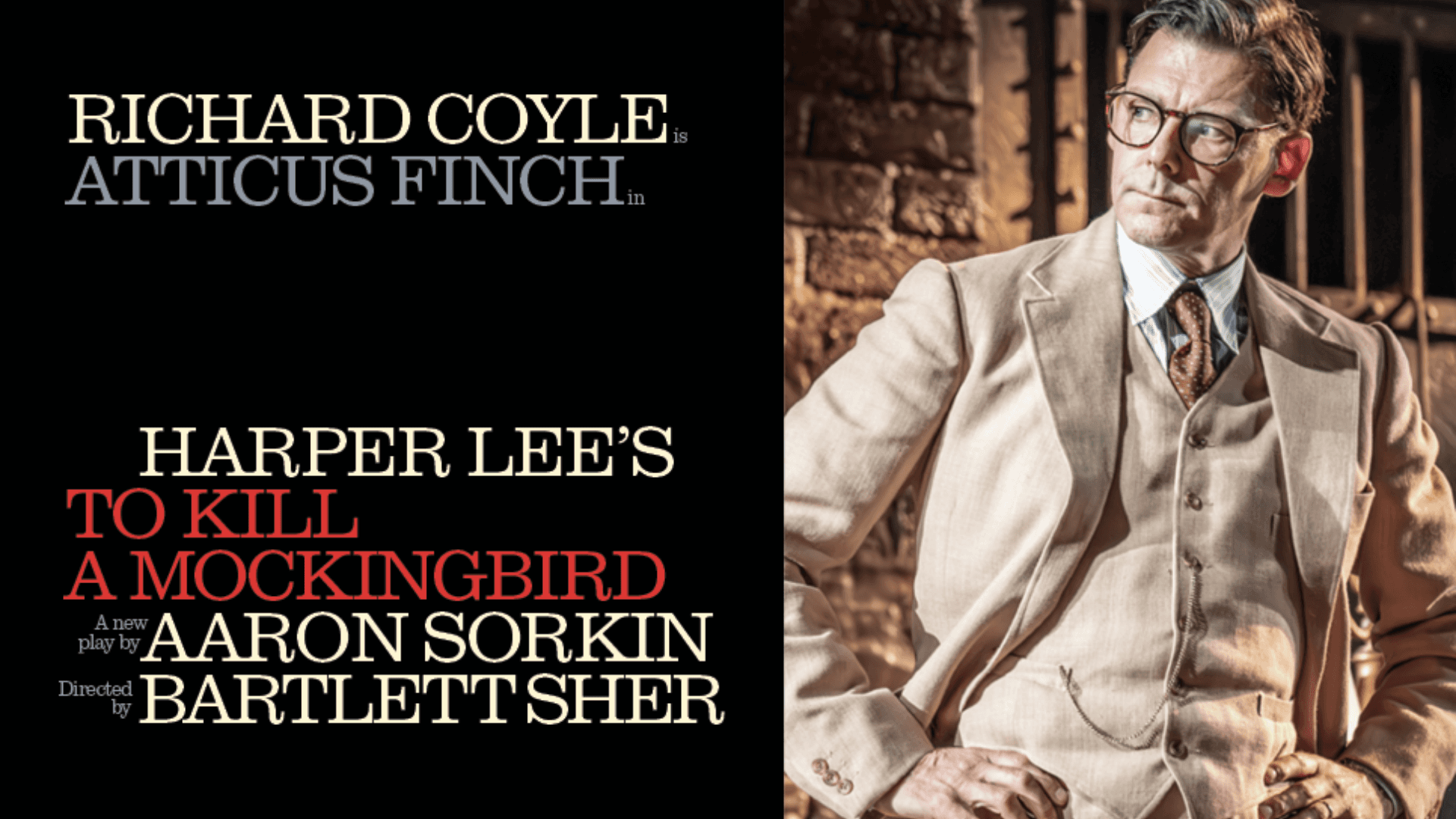
There are some stories that refuse to lose their relevance, no matter how many decades pass since they were first told. Harper Lee's To Kill A Mockingbird is one of them. Aaron Sorkin's Tony Award-winning stage adaptation, now playing at the Gielgud Theatre with Richard Coyle reprising his role as Atticus Finch, arrives back in the West End at a moment when its themes feel not just timely, but urgent. This is a production that reaches beyond the boundaries of literary nostalgia, confronting audiences with questions about prejudice, complicity, and moral courage that cut straight to the heart of contemporary life.
A Story Set in the 1930s That Mirrors the Present
To Kill A Mockingbird is set during the Great Depression in the fictional town of Maycomb, Alabama. The plot centres on lawyer Atticus Finch and his defence of Tom Robinson (Aaron Shosanya), a Black man falsely accused of assaulting a white teenager, Mayella Ewell (Evie Hargreaves). Beneath the surface of this courtroom drama lies a corrosive portrait of small-town prejudice, herd mentality, and the construction of scapegoats from vulnerable communities.
What makes this 2026 revival so striking is how effortlessly the production draws parallels between the racial injustice of 1930s Alabama and the divisions we see in our own society today. Though the specific language of bigotry may have shifted, the underlying mechanisms of prejudice, fear of otherness, and the weaponisation of marginalised groups remain disturbingly familiar. Characters like Bob Ewell (Oscar Pearce), an uneducated widower who has lost his job and channels his frustration into hatred towards the Black community, feel less like historical relics and more like composites of figures we encounter in today's news cycle. The far right's enduring comfort in scapegoating minority groups is, as this production makes viscerally clear, nothing new.
Richard Coyle's Atticus Finch: Hero and Question Mark
Richard Coyle brings a measured authority to Atticus Finch, delivering the character's famous courtroom speeches with quiet conviction rather than grandstanding rhetoric. What Sorkin's script does so well, and what Coyle's performance underscores, is to interrogate the idea of the white saviour. Atticus is a good man, but the adaptation refuses to let him, or the audience, off the hook with simple hero worship. There is a tension built into the role that asks whether being on the right side of an argument is enough when systemic injustice prevails regardless.
The famous Atticus Finch quote about climbing inside another person's skin and walking around in it has long served as a liberal touchstone. But this production pushes deeper, suggesting that understanding prejudice intellectually is only the first step. It is the silence of the bystanders, the reasonable people who see injustice unfold and do nothing, that ultimately enables the system to grind on. The jury's verdict, delivered through the repeated utterance of a single devastating word by the three child narrators, is a masterclass in theatrical tension. Each "guilty" lands like a hammer blow, the silence in the auditorium between each word growing heavier and more suffocating.
The Young Cast Delivers Extraordinary Performances
While Coyle anchors the production with gravitas, it is the young performers who provide its emotional heartbeat. The story is narrated through the eyes of Atticus's children, Scout (Anna Munden) and Jem (Gabriel Scott), along with their neighbour and friend Dill Harris (Dylan Malyn). Their perspective transforms what could be a straightforward legal drama into something richer: a coming-of-age story in which innocence collides with the ugly realities of the adult world.
Anna Munden's Scout is a revelation. She captures the character's fierce intelligence and warmth without ever tipping into cuteness, making Scout feel like a real child navigating genuinely confusing circumstances rather than a dramatic device. Gabriel Scott brings a determined energy to Jem, portraying a boy on the cusp of understanding how deeply broken his community truly is. But it is Dylan Malyn's Dill who may leave the most lasting impression. Malyn's portrayal suggests a neurodivergent child, one who misses certain social cues, over-rehearses others, and experiences the injustice around him with an almost unbearable intensity. This reading adds a fresh, deeply affecting layer to the character, making Dill not just the comic relief or the outsider, but a prism through which the audience sees how devastating injustice can be for those who feel everything too keenly.
Sorkin's Script Deepens and Challenges the Source Material
Aaron Sorkin's adaptation has always been more than a faithful retelling of Harper Lee's novel. His version gives significantly more depth to Calpurnia, the Finch family's Black housekeeper, who in the novel remains largely a background figure. On stage, Calpurnia is given the space to voice her own perspective on the case, on Atticus's approach, and on the wider experience of being Black in the Jim Crow South. This serves to challenge the narrative's original framing, which tells a story about racial injustice almost entirely through white eyes. The production does not shy away from this tension, and it is all the stronger for it.
Sorkin also restructures the courtroom scenes to build suspense more effectively than the novel, intercutting testimony with the children's narration in a way that keeps the audience emotionally engaged even when the outcome is grimly predictable. The web of lies fabricated by Bob and Mayella Ewell is laid bare with surgical precision, making the jury's wilful blindness all the more damning.
Why This Production Matters in 2026
It would be easy to watch To Kill A Mockingbird and feel comfortably outraged at the prejudice of another era. The production's greatest achievement is that it refuses to let the audience settle into that comfortable position. The parallels between Maycomb's townsfolk and the dynamics of modern populism, the scapegoating of immigrants, the targeting of minority groups, the rise of hate crimes fuelled by anonymity and tribalism, are drawn with unmistakable clarity without ever feeling heavy-handed.
The production asks not just whether we would have the courage of Atticus Finch, but whether we already are the silent jurors, the ones who see injustice and look away. In a theatrical landscape dominated by musicals and spectacle, this is a play that demands something of its audience: genuine reflection.
Should You Book?
This is essential West End theatre. Whether you are a long-time admirer of Harper Lee's novel or coming to the story fresh, Aaron Sorkin's adaptation, elevated by Richard Coyle's nuanced lead performance and an exceptional young cast, delivers a theatrical experience that is both intellectually challenging and profoundly moving. The production runs at the Gielgud Theatre and is suitable for older children and teenagers, though parents should be aware that the play deals directly with themes of racism, sexual assault, and violence.
Book your tickets for To Kill A Mockingbird on BritishTheatre.com. You can also browse all plays currently running in London, explore West End shows, or see our full listing of available productions.
Susan Novak has a lifelong passion for theatre. With a degree in English, she brings a deep appreciation for storytelling and drama to her writing. She also loves reading and poetry. When not attending shows, Susan enjoys exploring new work and sharing her enthusiasm for the performing arts, aiming to inspire others to experience the magic of theatre.
Stay in the spotlight
Get the latest theatre news, reviews and exclusive offers straight to your inbox.