The Shaftesbury Theatre on Shaftesbury Avenue is one of the older surviving theatres in the West End, with a history stretching back to 1911 and an auditorium that has hosted productions across the full range of the commercial and subsidised programme. It sits in the northern part of Theatreland, close to Holborn and Covent Garden, and its position and scale have made it a consistent home for large-scale musicals and plays that require a mid-to-large-capacity venue. This guide covers the history of the theatre, the character of the auditorium, the best seats at each level and what visitors need to know before arriving.
The Shaftesbury Theatre opened in 1911, designed in an Edwardian Baroque style by Bertie Crewe, who was responsible for a number of the West End theatres built in the early twentieth century. The original building had a capacity and architectural character suited to the variety programmes and musical entertainments that were the dominant form of commercial theatre in the years before the First World War.
The theatre's twentieth-century history includes one of the most celebrated and unusual episodes in West End history: the production of Hair, the American counterculture musical that ran at the Shaftesbury from 1968 and became the longest-running musical in West End history at the time. Hair's unprecedented five-year run defined the Shaftesbury's reputation for a generation and established it as a venue willing to programme work at the more adventurous end of the commercial spectrum. The run came to an abrupt end in 1973 when the ceiling of the auditorium partially collapsed, causing structural damage that closed the theatre for several years. The building was subsequently restored and the auditorium rebuilt, preserving the theatre's exterior character while renewing its interior.
In the decades since its reopening, the Shaftesbury has been associated with a range of productions including new musicals, revivals and plays. The venue has continued to maintain a programme that includes both mainstream commercial productions and work of a more distinctive character, in keeping with its history as a venue that has sometimes been home to shows that did not fit the established West End model.
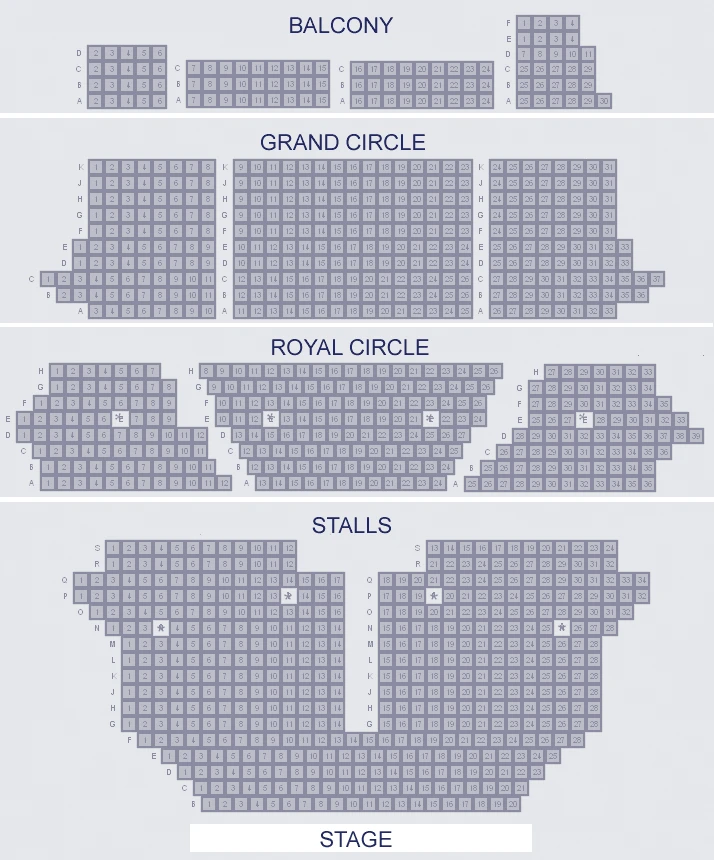
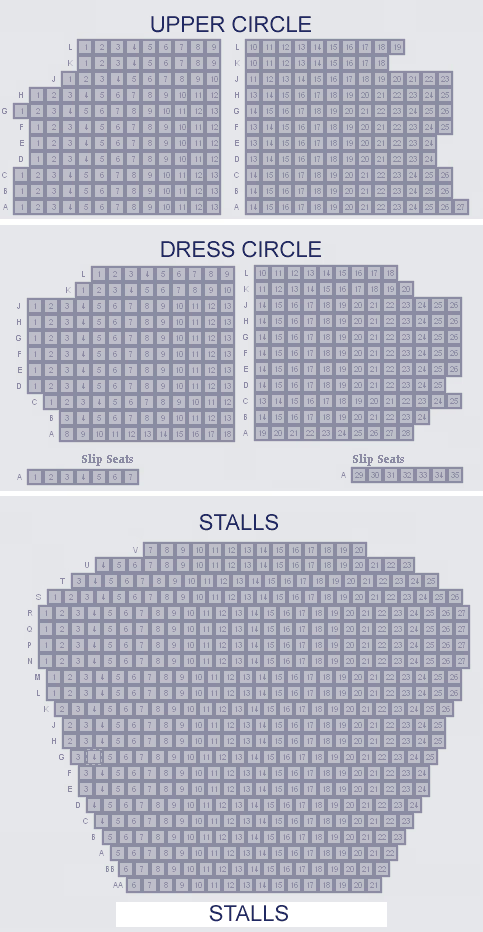
The Shaftesbury Theatre has a capacity of approximately 1,400 seats across three levels: Stalls, Dress Circle and Upper Circle. This makes it a mid-to-large house by West End standards, comparable in capacity to the Adelphi and Wyndham's but smaller than the very largest auditoria such as the Theatre Royal Drury Lane.
The auditorium retains a traditional form, with the typical West End layout of a raked stalls floor, overhanging circle levels and a proscenium stage. The acoustics are suited to musical productions, with sound carrying clearly at all levels. The sightlines at the Shaftesbury are generally good across the central areas of each level; side positions at the circles, as in most similarly configured theatres, can result in a partially obstructed view depending on the production's staging.
The stage is well-equipped technically, with the height and depth to support large-scale productions. The venue's capacity and configuration make it particularly appropriate for productions that need more than an intimate house can provide but do not require the scale of the largest West End venues. Audiences familiar with productions like Wicked or Les Misérables at comparable mid-to-large West End houses will find the Shaftesbury's environment broadly familiar in scale and atmosphere.
Choosing the best seats depends on the kind of experience you are looking for and how the production uses the stage.
Stalls is the ground floor and provides the most immediate sense of proximity to the performance. The central block is the most reliably good area: rows in the middle range give a clear view of the complete stage and a strong sense of engagement with the production. The very front rows are close to the stage, which provides an intense experience but can make it difficult to take in the full width of the staging for productions that use the whole stage floor. The rear Stalls is further from the stage and, depending on the rake, may not offer quite the same sense of connection as the mid-Stalls.
For most productions at the Shaftesbury, the central Stalls from approximately the fifth row onward to around the fifteenth provides the best balance of proximity and clear sightlines. Side seats at the extremes of the Stalls may cut off part of the stage for productions with wide staging.
Dress Circle offers the elevated overview that many regular theatre-goers prefer. The front central rows of the Dress Circle are among the most valued positions in the house: the elevation gives a clear view of the complete stage picture and reveals the full choreographic or design ambition of the production in a way that ground-level seating does not always allow. For shows with significant staging across the full width of the stage, the Dress Circle perspective is often more satisfying than the Stalls. The Dress Circle is also the level of choice for audiences who want to avoid the feeling of looking upward at raised staging in productions where the action is elevated.
The side positions in the Dress Circle should be checked carefully: depending on seat position, the overhang of the gallery above can reduce the sightline to certain parts of the stage.
Upper Circle provides a panoramic view at a greater physical distance from the stage. The central positions in the Upper Circle give clear sightlines to the full stage, and at a venue like the Shaftesbury, where the acoustic quality at the highest level is generally serviceable, the Upper Circle offers a practical option for audiences where price is the primary consideration. The distance from the stage does mean that individual performer detail is less apparent at this level, but for productions where the musical or storytelling experience is the primary draw, the Upper Circle delivers it at a lower price.
At all levels, central seats are strongly preferable to restricted-view side positions for productions that use the full playing area.
The Shaftesbury Theatre is on Shaftesbury Avenue in the West End. The nearest Underground stations are Holborn (Central and Piccadilly lines) and Tottenham Court Road (Central and Northern lines), both within five to ten minutes on foot. Covent Garden (Piccadilly line) is also within walking distance.
The area is within or adjacent to the London Congestion Charge zone; public transport is recommended for arriving close to curtain-up time. Shaftesbury Avenue and the surrounding Covent Garden and Holborn areas offer a wide range of pre-theatre dining at all price points within a short walk.
For tickets to productions at the Shaftesbury Theatre, tickadoo covers full seat availability with an interactive seat map and pricing at all levels. Central seats at circle level and mid-Stalls positions book early for popular productions; advance booking is recommended, particularly for weekend performances. For the complete West End programme and full current listings, BritishTheatre.com covers all venues and shows, and tickadoo also offers theatre gift vouchers.
What is the Shaftesbury Theatre? The Shaftesbury Theatre is a West End venue on Shaftesbury Avenue, originally opened in 1911. It has a capacity of approximately 1,400 seats across three levels and a history that includes the long-running production of Hair in the late 1960s and early 1970s.
Where is the Shaftesbury Theatre? The Shaftesbury Theatre is on Shaftesbury Avenue in the West End. The nearest Underground stations are Holborn and Tottenham Court Road, both within ten minutes on foot.
What are the best seats at the Shaftesbury Theatre? The mid-Stalls central block and the front central rows of the Dress Circle provide the strongest combination of proximity and sightlines. Central positions at any level are preferable to restricted-view side seats.
How many seats does the Shaftesbury Theatre have? The Shaftesbury Theatre has approximately 1,400 seats across three levels: Stalls, Dress Circle and Upper Circle.
What productions has the Shaftesbury Theatre been known for? The Shaftesbury is particularly associated with the production of Hair, which ran from 1968 and became the longest-running West End musical of its era. More recently, the venue has hosted a range of new musicals and plays as part of the commercial West End programme.
Stay in the spotlight
Get the latest theatre news, reviews and exclusive offers straight to your inbox.