The Fortune Theatre on Russell Street in Covent Garden is one of the smaller and more intimate houses in the West End, a venue whose character is determined by its scale and by its position among the streets of Theatreland close to the Theatre Royal Drury Lane. This guide covers the theatre's history, the auditorium layout, access provisions and practical information for a visit.
The Fortune Theatre is at Russell Street, London WC2B 5HH, in Covent Garden. The building opened in 1924, one of several West End theatres constructed in the interwar period that have remained in continuous use as part of the London theatre landscape. The theatre was designed in a Georgian revival style and retains much of its original architectural character.
With a seating capacity of approximately 432 people across three levels, the Fortune Theatre is one of the smaller houses in the commercial West End. This capacity places it well below the large musical houses and among the more intimate producing venues in the district, suited to productions that benefit from the close relationship between a smaller audience and the performing space rather than to large-scale commercial musicals that require a house of 1,500 or more to be viable.
The intimacy of the auditorium is the Fortune's defining quality. From any seat in the house, the stage is within a relatively short distance of the audience. The theatre's scale reduces the hierarchy that larger houses create between different seating levels, and the experience of watching a performance in a 432-seat auditorium is qualitatively different from watching in a 2,000-seat house: the actors are closer, the emotional content of the performance is more immediate, and the shared experience of the audience in the space is more concentrated.
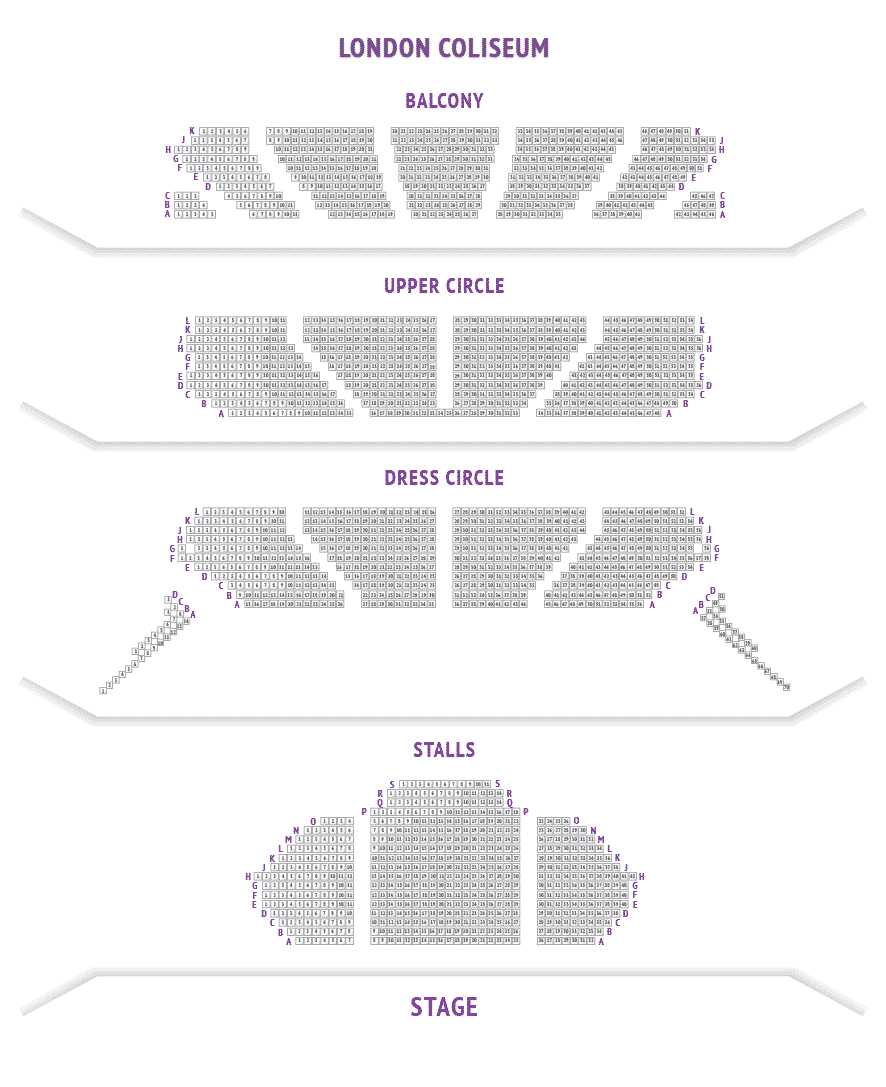
The Fortune Theatre has three seating levels: Stalls, Dress Circle and Upper Circle. In a house of this size, the differences between levels are less marked than in a larger West End venue, and even the upper level is a much shorter distance from the stage than the equivalent level in a house of 1,500 seats.
Stalls is the ground floor and the largest section of the auditorium in terms of seat numbers. The rake is gentle, giving adequate sightlines from the rear. The central section of the Stalls, from approximately rows D through to row M, provides the most direct engagement with the performance. The front rows are very close to the stage; in a theatre of this size, the front two or three rows give an unusually immediate experience of the performance, and the performers' expressions and physical detail are fully visible.
For productions that depend on performance quality and close observation rather than spectacle, the Fortune's Stalls is one of the best environments in the West End. The intimacy rewards acting of precision and detail in a way that a larger house cannot.
Dress Circle is the first balcony and provides an elevated view of the full stage picture. In a house of the Fortune's scale, the Dress Circle does not involve the significant distance from the stage that the equivalent level in a large musical house carries. The front central rows of the Dress Circle are an excellent position: the overview of the staging is clear, the performers are close, and the price is typically lower than the central Stalls.
Upper Circle is the highest level and the most affordable. In a theatre of the Fortune's size, the Upper Circle is a genuinely workable position: the stage is visible, the sound carries cleanly, and the experience of the performance is complete even from this level. The distance that makes the Upper Circle a compromise in a 2,000-seat house is considerably less significant in a 432-seat venue.
Restricted-view seats at the Fortune Theatre are at the extreme sides of the Stalls and Circle levels, where the angle of the seating limits the sightline to part of the stage. These are sold at a reduced price. For a small house of this scale, even mildly restricted-view seats are often preferable to an equivalent price category in the upper levels of a large house; the proximity to the stage compensates for a partial view in a way it would not in a more distant position.
The Fortune Theatre's original early twentieth-century construction presents some limitations in access provision, and the building does not offer the same level of accessibility as newer or recently renovated West End venues. Audience members with specific access requirements should contact the box office in advance to confirm what arrangements are available.
Wheelchair access. The Fortune Theatre has limited step-free access. Audience members with mobility requirements should contact the box office before booking to confirm the specific access arrangements and whether a suitable position is available for their needs.
Hearing loops. The theatre has an induction loop system. Audience members using hearing aids with a T-setting should contact the box office in advance for guidance on which positions offer the best loop coverage.
Audio description and captioned performances. Productions at the Fortune Theatre schedule audio description and captioned performances for specific dates throughout the run. When booking for an access need, confirm that the chosen performance includes the relevant provision.
Assistance dogs. Assistance dogs are welcome. Notify the box office when booking so that appropriate arrangements can be confirmed.
The Fortune Theatre is on Russell Street in Covent Garden and is well placed for several Underground stations.
By Underground: Covent Garden station (Piccadilly line) is approximately three to four minutes on foot, making it one of the most conveniently located West End theatres for Underground travellers. Temple station (Circle and District lines) is approximately ten to twelve minutes on foot.
By bus: The Strand and the surrounding streets are served by multiple bus routes. The nearest bus stops are on the Strand, a short walk from the theatre.
By National Rail: Charing Cross station is approximately fifteen minutes on foot via the Strand.
By car: The area is within the London Congestion Charge zone. Parking in Covent Garden is very limited; public transport is strongly recommended.
Russell Street and the surrounding Covent Garden area offer a high concentration of restaurants, cafes and bars within easy walking distance. The main Covent Garden piazza is a few minutes from the theatre, and Long Acre, Neal's Yard and the surrounding streets of Covent Garden provide options across all price points.
For pre-theatre dining, booking in advance is advisable for the better-known restaurants in the immediate area on busy evenings. The further from the main Covent Garden tourist area the restaurant is, the more likely it is that walk-in space will be available.
The Fortune Theatre's capacity of approximately 432 makes it one of the smaller commercial West End houses. This is a fundamentally different experience from attending productions at the large musical houses. While a show like Hamilton at the Victoria Palace Theatre or The Lion King at the Lyceum Theatre uses scale and spectacle as central theatrical tools, productions at the Fortune depend on the intimacy of the space and the precision of the acting rather than on technical ambition.
For audience members who attend the West End primarily for musicals and spectacle, the Fortune may represent a different kind of theatrical experience. For those who come to the theatre for acting, text and the close observation of performance, the Fortune is one of the most rewarding environments in the West End.
For tickets to productions at the Fortune Theatre and across all West End venues, tickadoo covers full availability with seat maps and pricing. tickadoo also offers theatre gift vouchers for occasions.
Where is the Fortune Theatre? The Fortune Theatre is at Russell Street, London WC2B 5HH, in Covent Garden. The nearest Underground station is Covent Garden (Piccadilly line), approximately three to four minutes on foot.
What is on at the Fortune Theatre? For the current production and performance schedule at the Fortune Theatre, BritishTheatre.com covers the full West End programme.
What are the best seats at the Fortune Theatre? The central Stalls gives the most immediate engagement with the performance. The front central rows of the Dress Circle provide a clear overview. In a house of the Fortune's size, even the Upper Circle is a workable position.
How many seats does the Fortune Theatre have? The Fortune Theatre seats approximately 432 people across Stalls, Dress Circle and Upper Circle.
Is the Fortune Theatre suitable for wheelchair users? The Fortune Theatre's access provision is limited compared to newer or recently renovated venues. Contacting the box office in advance is essential to confirm what access arrangements are available.
Stay in the spotlight
Get the latest theatre news, reviews and exclusive offers straight to your inbox.