Tom Stuart (Prophilus) and Amy Morgan (Penthea) in The Broken Heart. Photo: Marc Brenner The Broken Heart
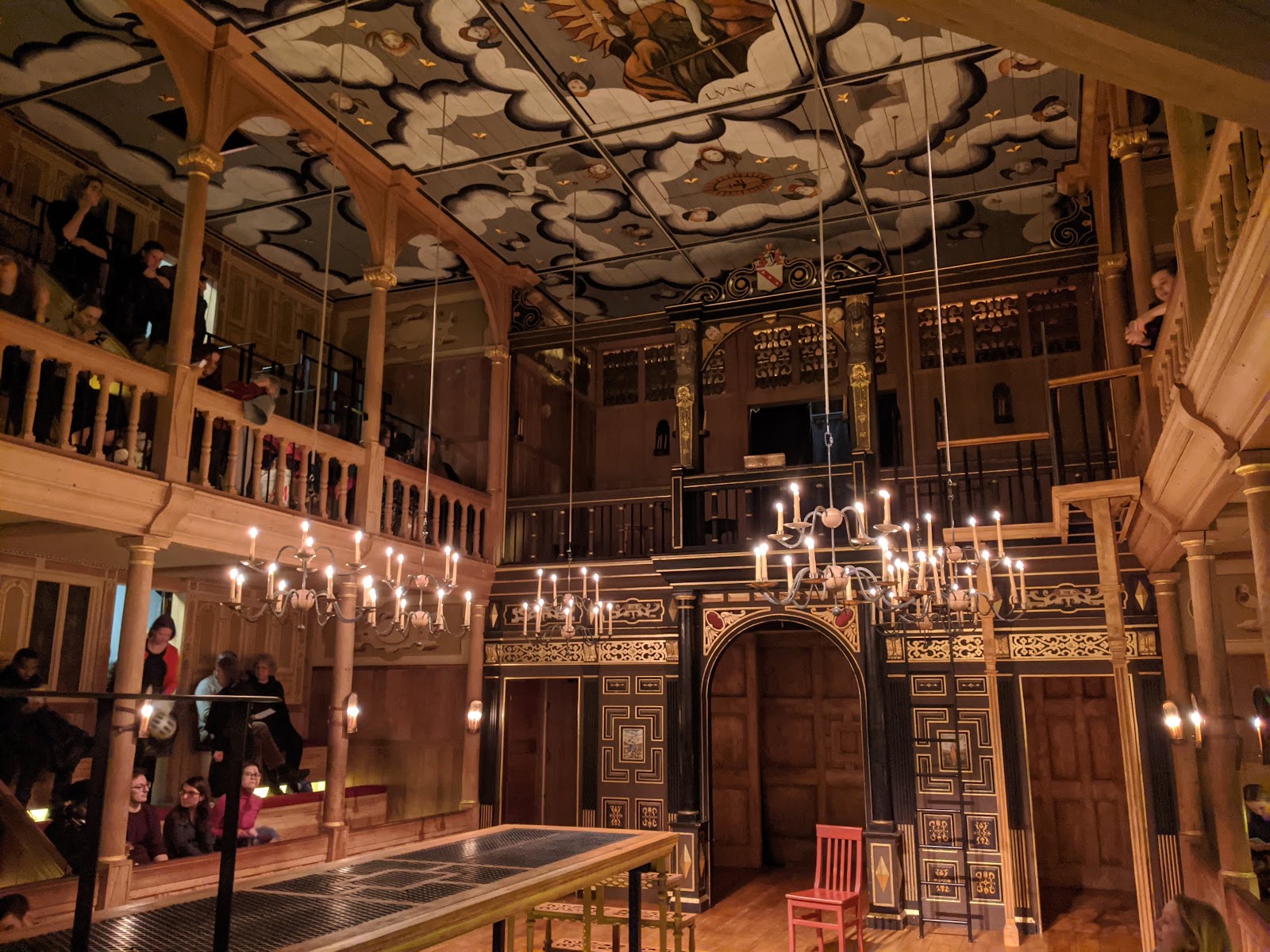
Sam Wanamaker Theatre
20 March 2015
2 Stars
"I was also struck with the murkiness of human existence that surrounds the entire play: the fact that people seem to make a decision and then renege, change their mind, and then try and plot toward something that never comes to fruition. I immediately started thinking, 'How do you approach a story like this? Do you try to 'solve' these 'problems', or do you let the play be the play? And of course it's far more interesting to let the play be the play, because all it's contradictions, red herrings and dead ends are what makes it so human...In preparation for rehearsals I wrote out the entire play by hand, line by line, translating it into my own English...the more we work, the more the story reveals itself to us. I have never felt that with a new play to quite this extent...The Broken Heart is a thinker's play, a play that asks you to go with people on a journey of self-discovery, self-examination...Ultimately we are dealing with a Caroline soap opera. Everyone is trying to get the best possible deal out of everyone else and men rule over women almost absolutely."
These mystifying words appear in the programme for The Broken Heart, a relatively unknown work from John Ford, first written, probably, in 1629 and now playing at the Sam Wanamaker Theatre, and are attributed to the director of the production, Caroline Steinbeis. Without anything else, these statements are revelatory - they indicate, with some precision, where this production has gone spectacularly off the rails.
The task of a director is to present the text in a way which illuminates the author's purpose. If there are 'problems', the director needs to find a way to solve them or at least to lessen their status as 'problems'. This can be achieved in any number of ways; the skill of the director is the sole limiting concept.
To consider The Broken Heart as a soap opera is to fundamentally misconceive it. The author seemed clear enough that it was a tragedy and the text certainly sounds like a tragedy. People die horribly because of their decisions or their reactions to the decisions of others. Most of the principal cast are dead by the finale, and not for any heroic or comic reason. There is a symphony of internal agony.
It is also a piece very firmly of its time. Ford was writing about the standards and ethics of Ancient Sparta, a civilisation different to the times in which he lived. What purpose could be served by 'translating' the play into modern language, unless the proposal was to mount the revival using that idiom? Far better, surely, to understand the text itself, why and when it was written, in order to be able to communicate meaning in the modern day?
Steinbeis' prism for this revival, the soap opera, is fundamentally misconceived. She omits from the production Ford's prologue which is tolerably clear about the tone of the piece:
"Our scene is Sparta. He whose best of art
hath drawn this piece calls it THE BROKEN HEART.
The title lends no expectation here
Of apish laughter, or of some lame jeer
At place or persons; no pretended clause
Of jests fit for a brothel courts applause
From vulgar admiration: such low songs,
Tun’d to unchaste ears, suit not modest tongues."
Despite Ford wanting the audience to have no expectation of "apish laughter", Steinbeis ensures the text is given an almost Carry On Gang treatment by the cast. Everyone plays for laughs. It is one thing for laughs to come naturally from text, character or incident; it is quite another to play for laughs because another way of bringing the text to life is outside your grasp.
The consequences of this Carry On Soap Opera approach are fatal. Firstly, the audience expects a comedy, so when Act Two turns into a serious bloodbath, there is natural incomprehension. Secondly, the early bastardisation of the characters for cheap laughs means that they have no authentic dramatic power when the plot twists to points where such power is needed. Thirdly, complex parts, such as Bassanes, who seems to completely change characteristics before and after Penthea's death, have no prospect of making coherent sense. All of this fundamentally affects the ability of the audience to understand and appreciate the play.
Steinbeis declares The Broken Heart is a "thinker's play". Perhaps. But possibly more thinking from the director would make the play more easily understood by the audience. The play is set in Sparta for a reason: it looks at the Spartan philosophy, favouring external calm and propriety over internal happiness, favouring self-restraint over self-expression. Arranged marriages come with consequences, as does treating women like chattels. These are the matters which occupy John Ford.
Penthea loves Orgilus but her brother, Ithocles, forces her to marry Bassanes. Bassanes worries that Penthea is not faithful and becomes obsessed with the possibility of her infidelity. Orgilus arranges to meet with Penthea in a garden and presses his desire for her, but she will have none of it because she considers herself unworthy of him (her having been married against her will to Bassanes). Penthea meets her brother and begs to be allowed to die rather than keep face in an unhappy marriage. Ithocles uses the opportunity to ask Penthea to help him woo, Calantha, the King's daughter. Despite the fate Ithocles has forced upon Penthea, she agrees. But Calantha is outraged that Penthea would presume to discuss such things with her. Shamed and desolate, Penthea goes mad and starves herself to death.
You can't really see Kenneth Williams and Barbara Windsor getting all giggly and jiggly with that storyline can you? Or Phil Mitchell, Sharon and Ian Beale? No. The play is a tragedy and it is a tragedy that Steinbeis has not directed it as such.
The cast are not the problem. Each and every one attacks the play with verve and in the style chosen by Steinbeis. That the attack is misconceived is not down to them.
Joe Jameson comes out of the mix as the best. He plays Nearchus, the Prince of Argos, a figure of fruity fun when he first arrives, midway through Act One. Jameson is precise and direct, he makes his character whole, funny when it does not distract, and regal and appropriate in other respects.
There is outstanding work too from Adam Lawrence who plays two roles: Phulas, servant to Bassanes, a camp, quick-tongued vassal; and Amelus, the staunch, deadly companion to Nearchus. So completely different, and real, are these performances that it is hard to believe Lawrence plays both. He is superb.
There is excellent work from both Tom Stuart (Prophilus) and Luke Thompson (Ithocles). Both play the dashing heroic type, but Stuart is the good guy and Thompson the bad, although Ithocles does try to redeem himself. Thompson is especially good in his death scene, where the circumstances are a little bizarre.
The direction prevents any of the other performances reaching great heights; motivations are too muddy for whole characterisations. Sarah MacRae does a sterling job as Calantha but the rush for laughs makes a mystery of her key scene with Penthea concerning Ithocles' intentions, forces her to deliver the dialogue prior to her death at break neck speed and sees her engage in two separate, but equally fatuous, dance sequences which rob her performance of sense.
As Penthea, Amy Morgan is slightly too perky for the setting and she never really recovers from the ludicrous dumb show which occurs before the action of the play starts properly. Again, the quest for laughs impedes the understanding of the situation she finds herself in and the heavy burden she feels.
Each of Brian Ferguson (Orgilus), Thalissa Teixeira (Euphrania), Owen Teale (Bassanes) and Patrick Godfrey (Amyclus) do the best they can, but the contradictions between text and directorial treatment put near impossible obstacles in their pursuit of clarity and completeness.
None of the cast are helped by the appalling incidental music from Simon Slater or the idiotic choreography from Imogen Knight. The opening of Act Two, a bizarre kind of cuckoo-clock dance break, is as bizarre a thing as I have ever seen on a classical stage. There is also some atrocious singing and very poor orchestral support from the band of four led by Adrian Woodward. All of this "embellishment" jars and is contrapuntal to any illumination of the text.
Designer Max Jones provides some good costumes, although the golden breastplate (and wings) that descends, like Cinderella's ball gown, from the heavens for Calantha's coronation (and death) is over the top in an Alexander McQueen kind of way. But he provides an excellent chair and the manner of Orgilus' slow-drip suicide is completely horrific (and perfect).
It was inevitable that there would finally be a disappointment on the Sam Wanamaker stage. After the success of Ford's well known 'Tis Pity She's A Whore, it's surprising - and sad - that The Broken Heart should be the production to break the good run. But there it is.
It was not just Calantha's heart that was broken at the end of this episode of Carry On Caroline.
The Broken Heart runs at the Sam Wanamaker Playhouse until 18 April, 2015
Stephen Collins is a contributor at British Theatre, covering West End productions, London theatre news, casting updates, and UK stage trends.
View profile and all articlesStay in the spotlight
Get the latest theatre news, reviews and exclusive offers straight to your inbox.