Miranda Raison and Shaun Evans in Hello/Goodbye. Photo: Manuel Harlan Hello/Goodbye
Hampstead Theatre
3 February 2015
2 Stars
"Peter Souter's Hello/Goodbye is his first play, a smart contemporary romantic comedy and a sort of Private Lives for our times." So opines Artistic Director Edward Hall in the programme notes for Hello/Goodbye which is now playing on the Main Stage at Hampstead Theatre, having had an inaugural run downstairs where "sensational word-of-mouth carried the run to over 97% capacity".
Three points need to be made with alacrity.
One, as a witty colleague noted, Private Lives is the modern Private Lives. Two, Hello/Goodbye might be many things but romantic comedy is not one of them.
Three, those responsible for the "sensational word of mouth" have much for which to answer.
The central problem with Souter's play is that it is not a play. It is a series of sketches from a television dramedy/comra turn into two long sketches. It depends upon the intense intimacy that Television can create and that, perhaps, can be somewhat replicated in a small space such as the Hampstead Downstairs. Perhaps.
Granted, it has an interesting premise: examine the first hour of a couple meeting and the last hour of their togetherness. You can see, at once, how that might be an interesting television series, with six episodes covering six different couples, nestling in the schedules of BBC3 or Channel 4 or ITV2. Equally, it might make for good radio drama.
Souter's background is writing for television and radio, and it shows. You can, as I did, for some time in the first Act, close your eyes and listen to the banter and get exactly the same level of pleasure as if your eyes were open. Creating the look and feel of the characters in your own mind helps alleviate the shortcomings in the theatrical experience.
The focus of Souter's attention here has been on the smart riposte, the clever put-down, the revealing insult, rather than on the characters who deliver those lines. In stage productions, character is just as, if not more, important than dialogue. If you cannot believe in the characters, the play cannot work.
The manner of these characters' meeting is beyond ludicrous: two different estate agents have managed to let the same flat to two different people at the same time and both turn up about the same time to move into it. Sparks fly. Romance ensues. Yes. Right.
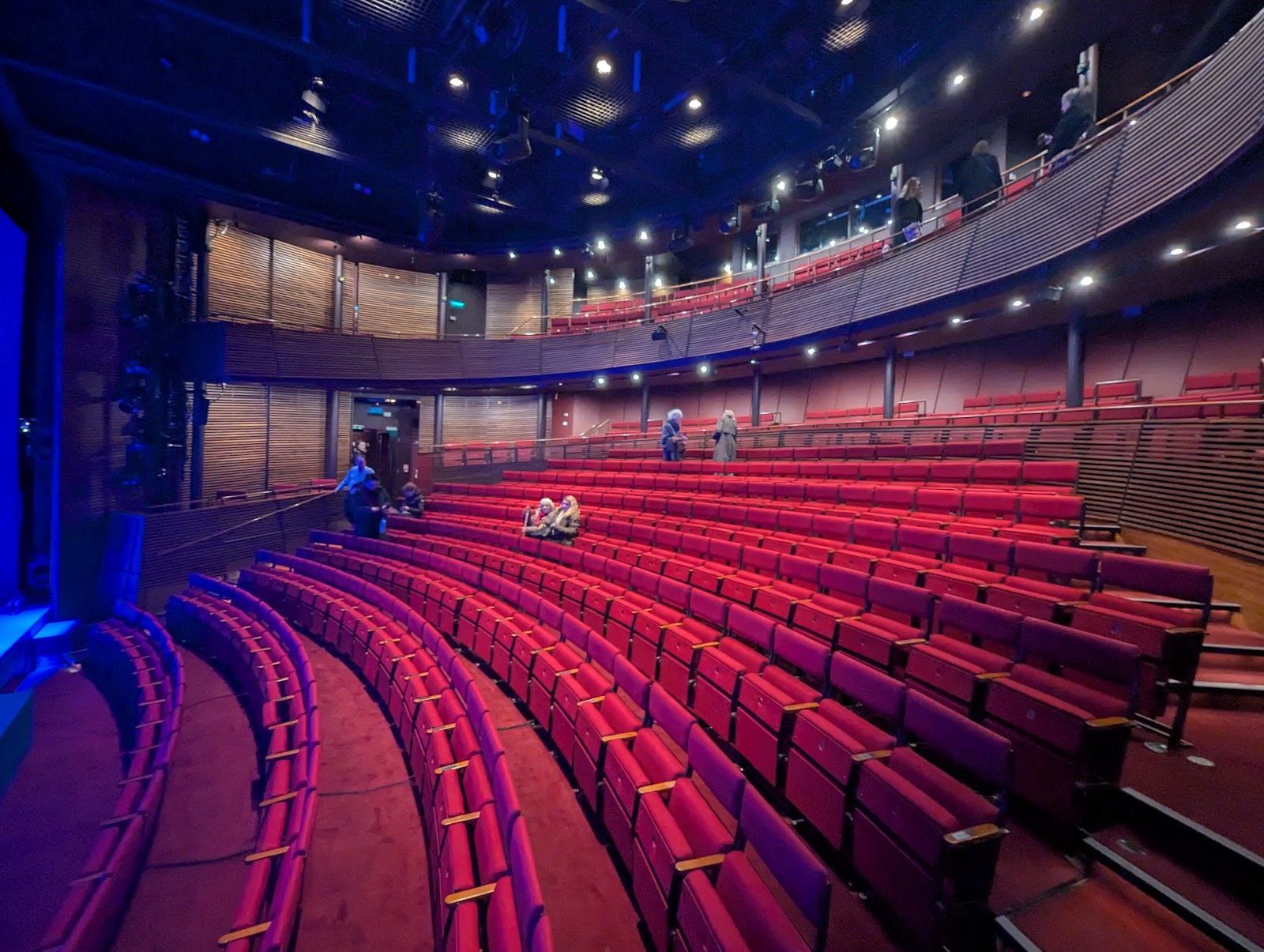
For reasons which escape me, the auditorium has been converted into a kind of Thrust staging for this production. Presumably, director Tamara Harvey and designer Lucy Osborne expected that to result in recapturing some of the intimacy the Downstairs space brought naturally to the piece. Except that Osborne's set is not capable of being seen properly from every seat: the play might be on a Thrust stage but it is played as though it is on a Proscenium Arch stage. Mystifying.
The central male character, Alex, is a bit of a loner, a twitchy introvert, a bespectacled, knowledgeable geek with a passion for collecting: he has whole collections of eclectic subjects - every McDonalds Happy Meal toy; signed photographs from everyone who ever walked on the Moon; unopened boxes of Star Wars figurines; bugs. You get the picture. Despite his self-confessed introvert status, he is able to boast to a complete stranger, a shrieking, potty-mouthed woman who is threatening him with a through beating at the hands of her rugby-playing boyfriend, about his inordinate sexual prowess, his ability to make love to "Commonwealth Games standard". His prowess might be believable; his showing off about it is at odds with everything about him.
Juliet, the central female character, collects male lovers. She seems incapable of being faithful and, having had sex with her boyfriend's best friend on the day of his wedding to another woman, is no longer with said boyfriend, hence her need to move into the flat of which Alex has taken possession. On the face of it, then, ideal relationship material for a careful, fastidious introvert. Well, perhaps in Bizarro world.
These improbable characters improbably joust, with banter as the weapon of choice, for some time and then even more improbably have sex. It's as banal as it is bizarre.
To be scrupulously fair, some of the dialogue makes one smile, occasionally one laughs out loud. But the overall experience is tedious and predictable (especially “the twist” in Act Two) and admiration for the odd well-crafted sentence is insufficient to justify the production.
What does make this production worth a look, if you have two hours to waste, are the performances, at least mostly. Shaun Evans demonstrates convincingly his skills as an actor - his enlivening of Alex is complex, rich in detail, and utterly beguiling. Every twitch, every re-alignment of spectacles, every tug at his jumper, every still moment to diffuse tension - all combine to produce a completely believable character coping with an unbelievable world.
Evans is especially good in his dealings with the two minor characters of the piece, Luke and Amanda. Luke is the betrayed ex-boyfriend of Juliet who comes to the flat after her shrill demands for his assistance. Leo Starr, filling in for an indisposed Luke Neal, was pitch perfect as the good looking nice guy trashed by Juliet. Evans and Starr quickly and effortlessly establish that kind of perfunctory male bonding that occurs when two chaps meet for the first time and have something in common but not much.
Bathsheba Piepe has the more difficult role, a mysterious interloper in Act Two. In her professional stage debut, Piepe is refreshingly engaging and quite a treat. When her appearance is explained, in retrospect, the work she has done to that point has been terrifically judged. She and Evans have exactly the right sort of chemistry to make their acquaintance ring perfectly true.
Naming the central female character Juliet must be Souter's idea of a clever device, because the character is as unlike Shakespeare's heroine as might ever be imagined. Capricious, selfish, shrill to the point of ear-drum splitting, cruel and sarcastic, this Juliet is spectacularly beautiful on the outside but ghastly on the inside. Miranda Raison, a gifted and compelling actress, does her best to make this caricature come to life but it is an uphill task. She is at her best in Act Two and more often than not she makes the material seem better than it is.
But the most serious shortcoming, especially in Act One, is the total lack of sexual chemistry between Raison and Evans. They barely manage a level of schoolyard friendship, let alone an honest adult relationship based on lust and love. This is about the writing more than anything else, but it fatally undermines the possibility of the play's success.
The underlying message of the "romance" at the centre of the play is that people must/should be willing to completely throw away or change the things which make them individuals, make them who they are, in order to make their partners happy. This is as surprising as it is unfathomable.
Hello/Goodbye is disappointing as a play, and especially as a romantic comedy. Evans and Raison do their best, Evans in particular, but their efforts, guided by Tamara Harvey, do not overcome the inherent problems in the text.
Unromantic and not particularly funny
Hello/Goodbye is running til 28 February 2015 at Hampstead Theatre
Stephen Collins is a contributor at British Theatre, covering West End productions, London theatre news, casting updates, and UK stage trends.
View profile and all articlesStay in the spotlight
Get the latest theatre news, reviews and exclusive offers straight to your inbox.